OPC vs PPC Cement: Which Should You Choose?
Understanding the critical differences between Ordinary Portland Cement and Portland Pozzolana Cement — and making the right call for your construction project.
Introduction
When it comes to building a home, every material decision matters — but few carry as much long-term consequence as the type of cement you choose. Cement is the binding backbone of your entire structure, holding together the concrete in your foundations, the columns that bear your roof, the walls that surround your family, and the floors you walk on every day. Get the cement right, and you build a structure that lasts generations. Get it wrong, and you may face costly repairs, structural degradation, or moisture damage within a decade.
Two cement types dominate residential and commercial construction across the world: Ordinary Portland Cement (OPC) and Portland Pozzolana Cement (PPC). Both are Portland-based, meaning they share a common clinker foundation. Yet the differences in their composition, curing characteristics, strength development, and long-term performance are significant enough to make one meaningfully better than the other for specific applications.
This guide provides a comprehensive comparison of OPC and PPC — from their chemical composition to their real-world performance — so you can make an informed, confident decision for your next construction project.
What is Ordinary Portland Cement (OPC)?
Ordinary Portland Cement is the most widely used construction cement in the world. It was first developed in England in the early 19th century and derives its name from its resemblance to Portland stone, a type of limestone quarried on the Isle of Portland in Dorset.
OPC is manufactured by heating limestone and clay to very high temperatures — around 1,450°C — in a rotary kiln to produce a material called clinker. This clinker is then ground with a small amount of gypsum (typically 3–5%) to regulate setting time. The result is a fine grey powder that, when mixed with water, undergoes a chemical process called hydration, producing the hard, stone-like material we recognise as set cement.
Grades of OPC
OPC is available in three standard grades, classified by compressive strength at 28 days:
- OPC 33 Grade: Achieves a minimum compressive strength of 33 MPa at 28 days. Used for general construction where high early strength is not critical.
- OPC 43 Grade: The most commonly used grade for residential construction, achieving 43 MPa at 28 days. Suitable for foundations, columns, beams, and floors.
- OPC 53 Grade: The highest-strength grade, achieving 53 MPa at 28 days. Preferred for pre-stressed concrete, pre-cast elements, and high-rise construction.
Key characteristics of OPC
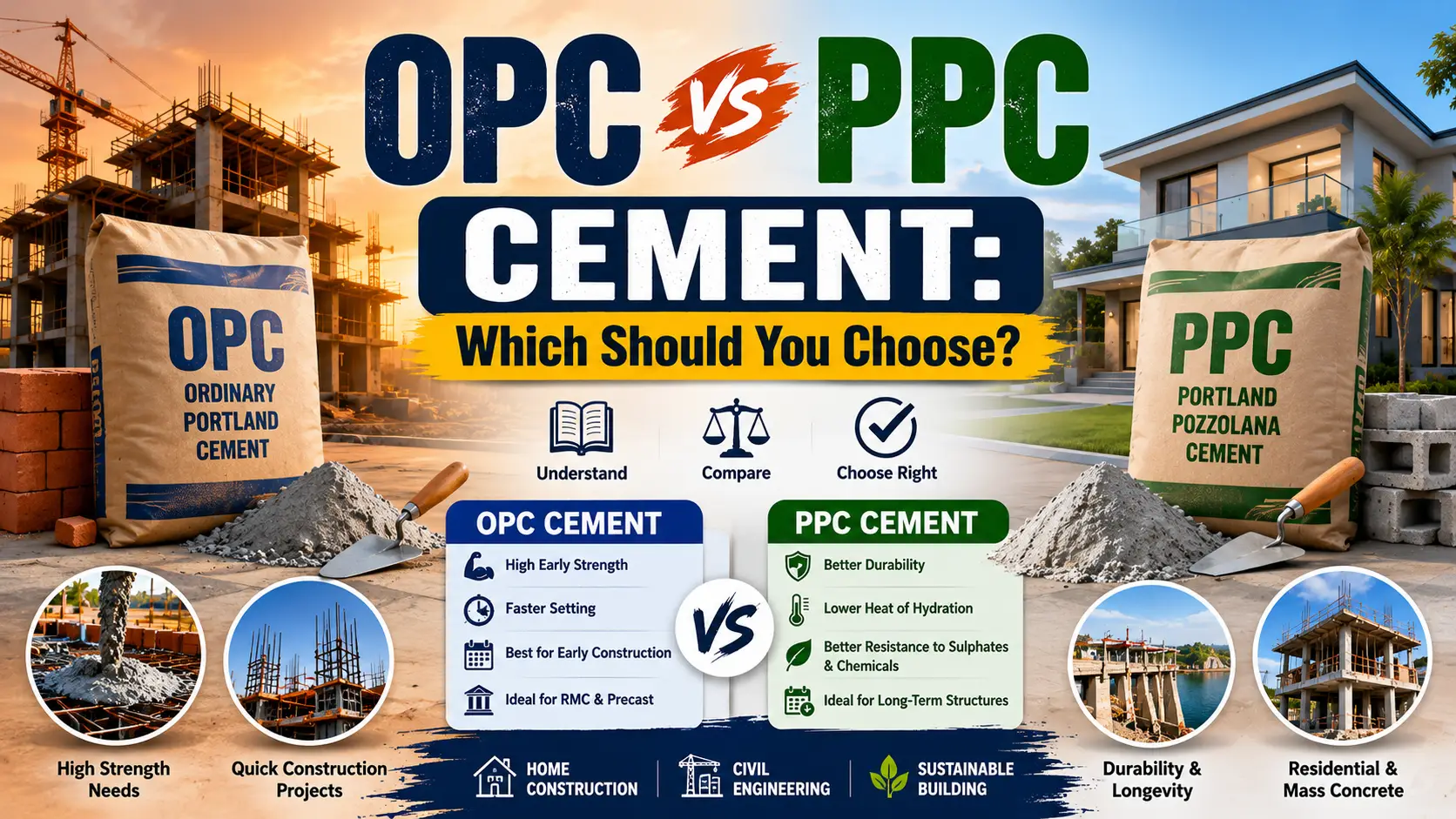
- Rapid early strength development — reaches significant strength within 3–7 days
- High compressive strength at 28 days
- Faster setting time, which shortens construction cycles
- Higher heat of hydration, making it less suitable for mass concrete pours
- Less resistant to sulphates, moisture, and chemical attack compared to blended cements
What is Portland Pozzolana Cement (PPC)?
Portland Pozzolana Cement is a blended cement produced by intergrinding or blending OPC clinker with pozzolanic materials, typically in proportions of 15–35% pozzolana by weight of the total cement content. The pozzolanic materials most commonly used are fly ash (a by-product of coal-fired power stations), volcanic ash, calcined clay, or silica fume.
The term ‘pozzolana’ comes from Pozzuoli, a town near Naples in Italy, where volcanic ash was first discovered to have remarkable binding properties when combined with lime and water. The Romans famously used this material to construct structures that have survived over two thousand years, including parts of the Pantheon.
In PPC, the pozzolanic component does not have binding properties on its own. Instead, it reacts with calcium hydroxide — a by-product of OPC hydration that would otherwise be washed out or leached from the concrete — to produce additional calcium silicate hydrate (C-S-H) compounds. This secondary reaction densifies the microstructure of the hardened cement paste, reducing porosity and improving long-term performance.
Key characteristics of PPC
- Slower early strength gain (takes longer to reach 28-day strength of OPC)
- Comparable or superior long-term strength beyond 28 days
- Lower heat of hydration, reducing thermal cracking in large pours
- Superior resistance to moisture, sulphates, and chemical attack
- Better workability due to the spherical shape of fly ash particles
- Reduced permeability leads to greater durability in aggressive environments
- Lower carbon footprint due to partial clinker replacement
OPC vs PPC: Side-by-Side Comparison
The table below summarises the key performance differences between OPC and PPC across the most important construction-relevant properties:
| Property | OPC — Ordinary Portland Cement | PPC — Portland Pozzolana Cement |
| Setting Speed | Fast (initial set 30–45 min) | Moderate (initial set 45–60 min) |
| Early Strength (7 days) | Very High | Moderate |
| Final Strength (28 days) | High | Comparable to OPC |
| Long-term Durability | Good | Excellent |
| Moisture Resistance | Moderate | High |
| Heat of Hydration | Higher | Lower |
| Sulphate Resistance | Low | High |
| Workability | Standard | Slightly better |
| Environmental Impact | Higher CO₂ | Lower CO₂ (uses fly ash) |
| Cost | Slightly lower | Slightly higher |
Strength Development and the Curing Factor
One of the most common misconceptions about PPC is that its slower early strength gain makes it an inferior material. This is incorrect. PPC’s slower development is a trade-off, not a deficiency — and it is a trade-off that pays off over time.
OPC achieves the bulk of its strength rapidly. This is extremely useful in construction contexts where formwork needs to be removed early, where pre-cast elements need to be handled within days, or where cold-weather construction slows down hydration and an accelerated mix is needed. In these scenarios, OPC’s faster strength gain is a genuine operational advantage.
PPC, by contrast, continues to gain strength over months. The pozzolanic reaction is slow and depends on the ongoing availability of calcium hydroxide and moisture. At 28 days, PPC concrete may be marginally lower in strength than equivalent OPC concrete. But at 90 days, 6 months, or a year, PPC concrete typically matches or exceeds OPC in compressive strength — and its microstructure is denser and less permeable.
“PPC’s slower strength development is not a weakness — it is a trade-off. Given time and proper curing, the denser microstructure it produces can outlast OPC concrete by decades in aggressive environments.”
Why curing matters more with PPC
Because PPC relies on a secondary reaction that requires both moisture and time, the quality and duration of curing has an outsized impact on final performance. If PPC concrete is allowed to dry out prematurely, the pozzolanic reaction is starved of water and the cement paste remains more porous than it should be.
As a general rule, PPC concrete should be wet-cured for a minimum of 14 days, compared to 7 days for OPC. On site, this means consistent water curing through hessian sacking, curing compounds, or pond curing for masonry elements. Builders who treat PPC the same way as OPC in terms of curing duration often underperform the material’s potential and draw incorrect conclusions about its suitability.
Which Applications Suit OPC and Which Suit PPC?
The performance differences between OPC and PPC translate into clear application preferences. Neither cement is universally superior. Each excels in a distinct set of conditions.
Where OPC performs best
- Pre-cast concrete elements where early demoulding is essential
- Road pavements, runways, and bridges requiring rapid strength for traffic loading
- High-rise structural concrete frames where fast formwork cycling reduces construction time
- Cold-weather construction where slow hydration is a risk
- Rapid repair works requiring quick return to service
- Grouting operations and applications requiring fast initial set
Where PPC performs best
- Residential foundations, slabs, and footings exposed to groundwater or dampness
- Masonry, plastering, and finishing works where workability matters
- Marine and coastal structures exposed to seawater and chloride attack
- Sewage treatment plants and underground construction exposed to sulphates
- Large volume pours such as raft foundations, where low heat of hydration prevents thermal cracking
- Construction in hot and humid climates where durability over strength is the priority
- Any structure where long service life in an aggressive environment is the key design criterion
Sustainability: The Environmental Case for PPC
Beyond performance, PPC carries a meaningful environmental advantage that is increasingly relevant for construction projects aiming to reduce their carbon footprint.
Cement production is responsible for approximately 8% of global CO₂ emissions. The primary source of these emissions is the calcination of limestone to produce clinker, which releases CO₂ as a direct chemical by-product — not just from burning fuel. Clinker production is therefore the most carbon-intensive step in cement manufacturing, and any reduction in clinker content per tonne of cement delivered reduces emissions proportionally.
PPC achieves this reduction by replacing 15–35% of clinker with fly ash or other pozzolanic materials. Fly ash is an industrial by-product that would otherwise be disposed of in landfill or ash ponds — using it in cement not only reduces clinker demand but also diverts waste from disposal. The result is a cement that can deliver 20–30% lower CO₂ emissions per tonne compared to OPC, while maintaining — and in many applications exceeding — OPC’s long-term performance.
For homeowners and developers who are tracking the environmental footprint of a build, or for projects seeking green building certification, PPC offers a pragmatic path to lower embodied carbon without compromising structural integrity.
Making the Right Choice for Your Home
For the majority of residential construction applications, PPC is the pragmatic choice. Its superior moisture resistance, reduced permeability, long-term durability, and lower heat of hydration make it well suited to the typical conditions a home must endure over decades: seasonal temperature variation, ground moisture, rain, and the gradual chemical action of the soil and atmosphere.
The slower early strength of PPC is rarely a constraint on domestic construction timelines. Most residential projects do not require formwork to be struck within 24 hours, and the pace of work in a typical home build naturally allows PPC the time it needs to develop full strength before critical loading.
Use OPC when speed is genuinely the priority: rapid pre-cast production, urgent structural repair, or large-scale commercial construction where formwork cycling directly affects programme. In these contexts, OPC’s early strength advantage translates into tangible time and cost savings.
When in doubt, consult a structural engineer or construction materials specialist. The right cement depends not only on application type but also on your local climate, the specific mix design, water-to-cement ratio, and the curing conditions available on site. What matters above all is that whichever cement you select, it is used at the correct mix proportions and cured with the patience the material demands.
Conclusion
OPC and PPC are both excellent construction materials — but they are optimised for different priorities. OPC delivers fast, high strength and is unmatched when construction speed is the dominant constraint. PPC delivers superior long-term durability, moisture resistance, and sustainability, and is the better choice for most residential applications where the structure must perform reliably over decades.
Understanding the difference is not merely an academic exercise. The cement you choose will be locked into your structure the moment it sets — and its consequences, good or bad, will unfold over the lifetime of the building. Choose deliberately, cure properly, and your home will stand as testament to both.
Check: Understanding Load-Bearing Walls in Residential Buildings
Check: The Institution of Civil Engineers homepage | Institution of Civil Engineers (ICE)