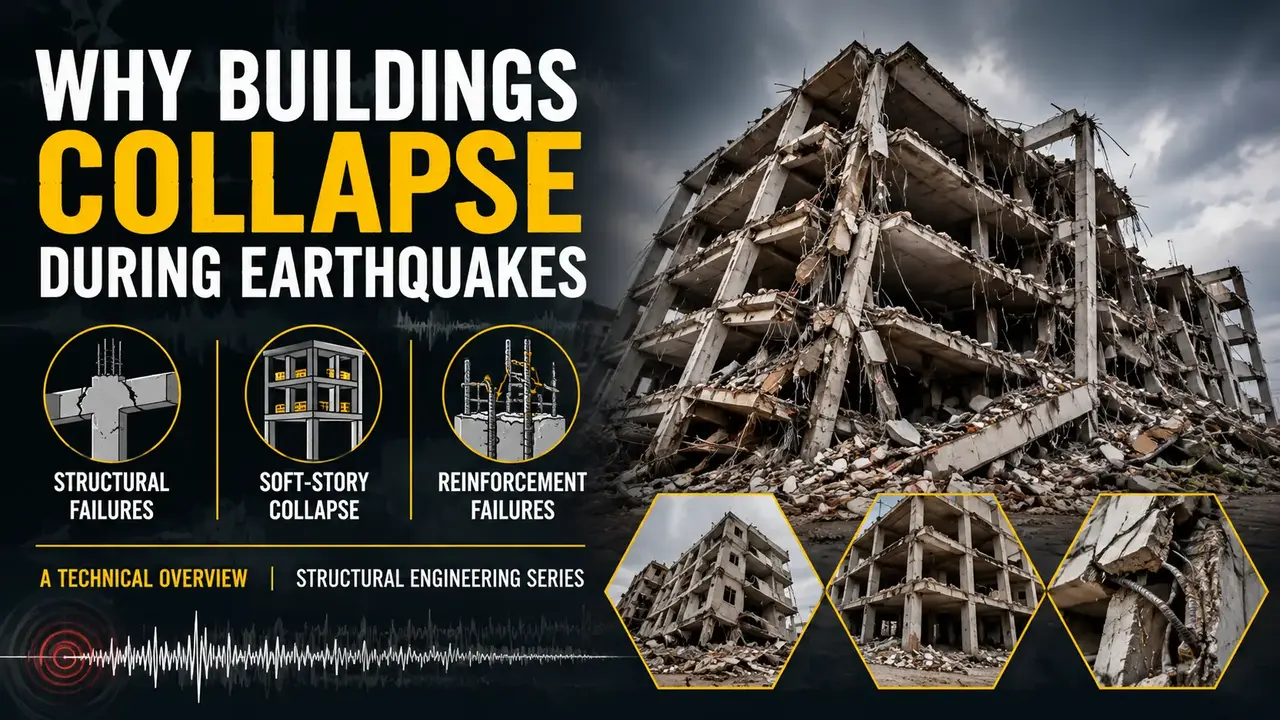
Why buildings collapse during earthquakes
Earthquakes do not kill people — buildings do. This stark truth, repeated by structural engineers after every major seismic event, encapsulates one of the most important lessons in disaster science. In the 30 seconds or less that a major earthquake typically lasts, thousands of structures can fail, burying occupants under tonnes of rubble. Yet identical ground shaking will leave some buildings standing and reduce others to dust. The difference lies not in the earthquake itself, but in how each building was designed, built, and maintained.
This article examines the three dominant mechanisms behind earthquake-induced building collapses: the fundamental structural failures triggered by lateral seismic forces, the disproportionate destruction caused by soft-story configurations, and the critical role of steel reinforcement — and what happens when it is absent, insufficient, or poorly detailed.
Understanding these mechanisms is not merely academic. Millions of people worldwide live and work in buildings that remain dangerously vulnerable to ground shaking. Identifying the failure modes is the first step toward retrofitting, regulation, and saving lives.
1. How Earthquakes Load a Building
A building is designed primarily to resist gravity — the downward weight of floors, walls, furniture, and occupants. Seismic forces are fundamentally different: they act horizontally, or laterally, pushing the building sideways in rapid oscillating pulses. The building’s own mass, which was an asset in resisting gravity, becomes a liability: the heavier the structure, the greater the inertial force generated by ground acceleration.
When the ground shakes, it moves beneath the building’s foundations. The base moves with the ground immediately, but the upper floors lag behind due to inertia — like a passenger lurching backward when a bus accelerates. This relative displacement between floors is called story drift. If the structural frame can absorb and dissipate the energy of this drift — bending elastically and returning — the building survives. If it cannot, failure begins.
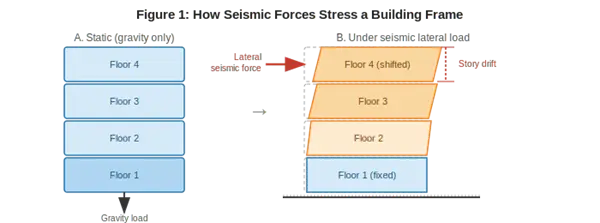
Figure 1: Static gravity loads (A) act vertically downward. Under seismic loading (B), lateral forces cause horizontal story drift, imposing tension, compression, and shear simultaneously on every structural member.
The critical structural demands during an earthquake are threefold. Shear forces attempt to slide one part of a member relative to another. Bending moments try to rotate elements at their connections. Axial forces — compression or tension — act along the length of columns. A building must resist all three simultaneously, in rapidly reversing directions, for the duration of the event.
“The ground shaking in a major earthquake can reverse direction 10 to 20 times per second. Every structural joint must survive each reversal without fracture or separation.” — Earthquake Engineering Research Institute
2. Primary Structural Failure Modes
2.1 Column Failure and Pancake Collapse
Columns are the critical load path in most building structures. They carry the entire weight of the floors above and must transfer both vertical gravity loads and horizontal seismic forces to the foundations. When a column fails — whether through shear fracture, buckling, or connection rupture — the floor it supports loses bearing instantly. There is no redistribution of load and no warning.
The most catastrophic outcome is the pancake collapse, in which successive floors fall vertically onto each other in a chain reaction. Each floor’s weight adds to the impact load on the floor below, which is already compromised; the cascade accelerates. The resulting stack of slabs leaves almost no survivable void space. Pancake collapses were responsible for the majority of fatalities in the 1999 Izmit earthquake in Turkey (17,000 deaths), the 2010 Haiti earthquake (over 200,000 deaths), and the 2023 Kahramanmaras earthquake sequence.
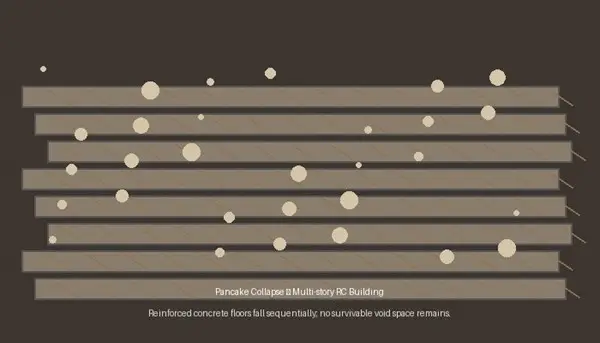
Illustration 1: Schematic of a pancake collapse. Reinforced concrete floor slabs fall in sequence as columns fail; rebar extending from the slabs is the primary visual indicator of the failure mode.
2.2 Beam-Column Connection Failure
In a moment-resisting frame — the structural system used in most mid- and high-rise buildings — beams and columns are rigidly connected so that bending moments can transfer between them. This rigidity is what gives the frame its lateral stiffness. But it also means the connections are highly stressed during seismic loading.
Connection failures typically occur when welds fracture in steel frames, when poorly anchored reinforcing bars pull out of concrete joints, or when the joint itself — the region of concrete at the beam-column intersection — cracks under the combined shear and bending it experiences. Once a connection fails, the frame becomes a mechanism: a structure that can deform freely without resistance. Moment frame connection failures were a defining feature of the 1994 Northridge earthquake, where hundreds of welded steel connections fractured in ways engineers had not anticipated, prompting a fundamental reassessment of steel detailing practice.
2.3 Shear Wall Failure and Torsional Collapse
Shear walls — reinforced concrete or masonry walls placed strategically within a building plan — are the primary lateral force-resisting elements in many building types. They work as deep vertical cantilever beams, fixed at the foundation and free at the roof, resisting the horizontal force like a dam resists water pressure. When shear walls crack, slide at their base, or overturn, the building loses its lateral bracing entirely.
A related and particularly dangerous phenomenon is torsional collapse, which occurs when the lateral stiffness of a building is not symmetric in plan. If shear walls or stiff frames are concentrated on one side of the floor plate, the building will twist during an earthquake rather than translate uniformly. The corners farthest from the center of rigidity experience the largest displacements and the highest demands — often leading to failure at the perimeter columns while the interior remains intact.
3. The Soft-Story Problem
Of all the building vulnerabilities exposed by earthquakes over the past century, the soft-story configuration is among the most reliably deadly — and among the most preventable. A soft story is any floor that is substantially weaker or more flexible in lateral stiffness than the floors immediately above it. The stiffness ratio that defines “soft” varies by code but is typically a reduction of 70 percent or more compared to adjacent stories.
The most common soft-story configuration in the United States, Latin America, and parts of Asia is the ground-floor garage: a wood-framed or lightly reinforced concrete building where the ground level is open for parking or retail, supported only by widely spaced columns with no shear walls between them, while the upper floors — which carry the bulk of the building’s weight — are densely walled and laterally stiff.
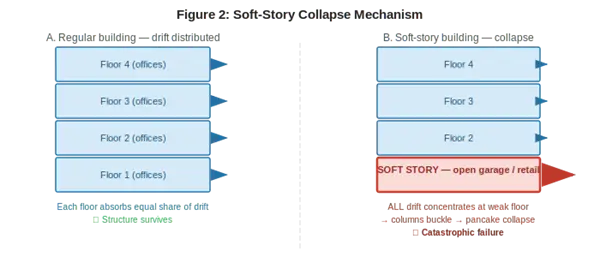
Figure 2: In a regularly stiffened building (A), seismic drift is distributed across all stories equally. In a soft-story building (B), the weak ground floor attracts virtually all lateral deformation; its columns are overwhelmed and buckle, precipitating total collapse while upper floors remain structurally intact.
The physics of the soft-story problem is straightforward: stiffness determines how deformation is distributed. In a building where all stories have approximately equal lateral stiffness, the earthquake-induced drift is spread across every level. Each story deforms a moderate amount, and no single level is overwhelmed. In a soft-story building, the lateral deformation concentrates almost entirely at the weak level, just as a chain breaks at its weakest link. The columns in the soft story are forced to accommodate all of the building’s seismic displacement, cycling through large angular deformations many times per second. They were designed for nothing of the sort.
“In the 1989 Loma Prieta earthquake, virtually every apartment building that collapsed in the San Francisco Marina District failed at the ground-floor garage level. The upper units were largely undamaged — except that they were now resting on the street.”
The Northridge earthquake of 1994 produced the same pattern in the San Fernando Valley. Hundreds of two- and three-story wood-frame apartment buildings with tuck-under parking collapsed at the ground floor, killing 16 people and displacing thousands of residents. A Los Angeles Department of Building and Safety survey after Northridge identified more than 40,000 soft-story wood-frame buildings in the city alone — a number that triggered a multi-decade mandatory retrofit program that continues to this day.
The economic incentive that produces soft stories — the desire for ground-floor commercial use or parking — means the configuration continues to be built in regions with inadequate seismic codes. In Turkey, the Philippines, and much of the developing world, ground-floor commercial conversions of originally residential buildings routinely remove shear walls that were present in the original design, creating soft stories by renovation. These informal interventions are invisible to regulators and catastrophic in earthquakes.
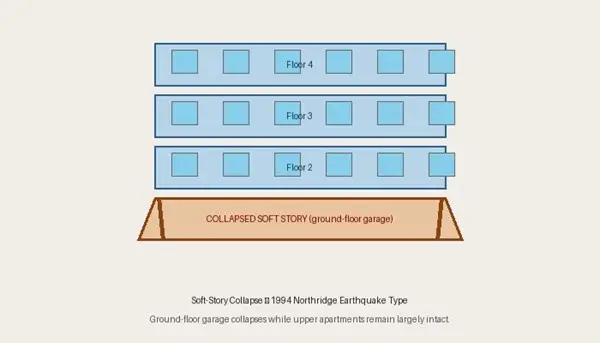
Illustration 2: Characteristic soft-story failure. The ground floor collapses entirely while the upper three stories descend as a largely intact unit. Note the lateral offset of the upper block relative to the foundation — evidence of the concentrated drift demand at the failed level.
4. Reinforcement: The Difference Between Life and Death
Concrete is the most widely used construction material on Earth — cheap, durable, compressive-strong, and workable in almost any form. It is also brittle. Under tension, plain concrete cracks at stress levels that are trivial by engineering standards. Steel reinforcing bars — rebar — exist precisely to supply what concrete lacks: ductility, tensile strength, and the ability to deform significantly before fracturing.
In a seismic event, every structural member experiences tension as well as compression, as the loading reverses direction repeatedly. A beam bending one way puts its bottom face in tension; a moment later, it reverses, and the top face is in tension. A column that carries vertical load in compression also experiences lateral bending that puts one face in tension. Without reinforcement, these tension demands crack and ultimately shatter concrete. With proper reinforcement, the steel carries the tension while the concrete carries the compression, and the composite material bends without breaking — a property called ductility that is the cornerstone of modern seismic design.

Figure 3: Three reinforcement conditions in concrete columns. (A) Without confinement ties, rebar buckles outward as concrete spalls under seismic loading. (B) Insufficient lap splice length causes bars to separate when cyclic tension is applied. (C) Properly spaced confinement hoops contain the concrete core and prevent bar buckling — the column survives repeated loading cycles.
4.1 Insufficient Rebar Density
The most fundamental reinforcement failure is simply too little steel. Building codes specify minimum reinforcement ratios — the cross-sectional area of steel as a proportion of the gross concrete area — based on decades of testing and post-earthquake observation. These minimums exist because below a threshold steel content, concrete members fail suddenly and completely rather than gradually and with warning. In many parts of the world, construction shortcuts, corruption in inspections, or the use of pre-seismic-era designs result in columns and beams with far less rebar than required. The result is catastrophic brittleness: elements that appear intact under gravity load snap immediately when lateral forces are applied.
4.2 Inadequate Confinement: The Missing Ties
Even when the correct number and size of longitudinal rebar are provided, a column can fail catastrophically if it lacks adequate transverse reinforcement — the ties, stirrups, or spiral hoops that wrap around the longitudinal bars at regular vertical intervals. These transverse elements serve several functions simultaneously. They resist the tendency of longitudinal bars to buckle outward when the concrete cover spalls off under compression. They confine the concrete core, preventing it from dilating and losing strength under cyclic loading. And they carry the shear forces generated by lateral loading.
Confinement is the single variable that most reliably separates columns that survive earthquakes from those that do not. Post-earthquake surveys consistently show that columns with closely spaced ties — at spacing of 100mm or less through the potential plastic hinge zones at the top and bottom of each column — perform dramatically better than those with widely spaced ties or no ties at all. The 2008 Sichuan earthquake in China, which killed nearly 70,000 people, revealed widespread use of concrete columns with ties spaced at 300 to 500mm throughout — three to five times the spacing that seismic codes require.
4.3 Short Lap Splices and Bar Pull-Out
Where one length of rebar ends and another begins, the two bars must overlap for a sufficient distance to transfer force between them through bond with the surrounding concrete. This overlap zone is called a lap splice. Seismic codes specify minimum lap lengths that are considerably longer than those required for gravity-only structures, because the cyclic tension and compression in a seismic event degrades the bond between steel and concrete much more rapidly than static loading.
In buildings constructed to pre-seismic codes or under inadequate inspection, lap splices are frequently too short. When cyclic loading degrades the bond, the bars simply pull apart — the structural member loses its tensile capacity instantaneously. Lap splice failures are particularly common at the base of columns, where the column rebar transitions from the foundation to the first-floor column — the location of maximum seismic demand. This failure mode was identified in nearly every major concrete building collapse examined after the 1999 Chi-Chi earthquake in Taiwan.
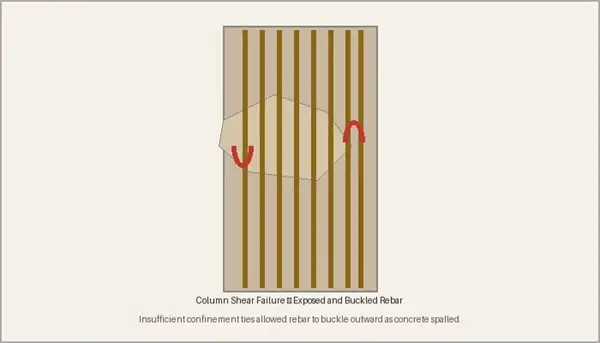
Illustration 3: Exposed column after earthquake damage. Longitudinal rebar has buckled outward in the spalled zone (left and right bars), indicating absent or widely-spaced confinement ties. The concrete core has disintegrated under cyclic compressive loading without confinement.
5. Compounding Factors: Why Some Buildings Are More Vulnerable
Structural failures rarely result from a single deficiency. The buildings most likely to collapse combine multiple vulnerabilities: a soft-story configuration at ground level, concrete with inadequate rebar, and poor quality control during construction that results in honeycomb voids in the concrete, incorrect concrete mix ratios, or corroded steel that has lost cross-section. These factors compound one another — a soft story with adequate reinforcement may survive where a soft story with poor reinforcement will not.
- Soil amplification: Buildings founded on soft sediments — reclaimed land, river deltas, alluvial soils — experience ground shaking that can be two to four times more intense than on bedrock, and of longer duration, because soft soils amplify and prolong seismic waves.
- Building age: Most countries adopted modern seismic design codes only after major earthquakes demonstrated the inadequacy of previous requirements. Buildings constructed before 1970 in the United States, before 1980 in Japan, and before the mid-1990s in Turkey were designed to standards now known to be dangerously insufficient.
- Structural irregularity: Beyond the soft story, any significant irregularity in stiffness, mass, or geometry — setbacks, re-entrant corners, mixed structural systems — creates stress concentrations and torsional responses that amplify demands on the weakest elements.
- Construction quality: Laboratory tests of concrete sampled from collapsed buildings after major earthquakes in Turkey, Haiti, and Nepal consistently reveal concrete with compressive strengths 30 to 60 percent below the specified values, and rebar that does not meet grade requirements.
6. What Makes a Building Survive
The properties that enable a building to survive an earthquake — collectively called seismic resilience — can be expressed in one word: ductility. A ductile structure is one that can deform significantly, absorbing and dissipating earthquake energy, without losing its load-carrying capacity. It bends; it does not break. Achieving ductility requires close attention to every element of the structural system and every connection within it.
Modern seismic design codes in Japan, New Zealand, the western United States, and a growing number of other countries mandate a capacity design approach: the structure is deliberately detailed so that damage, if it occurs, is confined to specific locations — the plastic hinges at the ends of beams — while columns, connections, and foundations are made strong enough to remain elastic. This controlled damage mechanism allows the building to absorb enormous energy without collapsing, and can often be repaired.
Beyond conventional reinforced concrete, base isolation — placing a building on flexible bearings that decouple it from the horizontal ground motion — represents the most effective intervention available. Base-isolated buildings in the 1995 Kobe earthquake and the 2016 Kumamoto earthquake performed dramatically better than conventionally founded structures nearby. The technology, once prohibitively expensive, has become increasingly cost-competitive and is now specified for hospitals, emergency operations centers, and critical infrastructure in seismically active regions worldwide.
For the vast existing stock of vulnerable buildings — the soft-story apartment buildings, the unreinforced masonry schools, the pre-code concrete frames — retrofit is the available tool. Steel moment frames inserted into soft-story ground floors, carbon-fiber wrapping of inadequately confined columns, and shear wall additions can bring existing buildings to acceptable seismic performance levels at a fraction of the cost of replacement. The gap between a building that stands and one that collapses is, at its root, a gap in investment, regulation, and political will — not a gap in engineering knowledge.
Conclusion
Every major earthquake reveals the same truths. Lateral forces overwhelm frames designed only for gravity. Stiffness irregularities concentrate damage at the weakest story. Concrete without adequate, properly detailed steel disintegrates under cyclic loading. These are not mysteries — they are well-understood mechanisms that can be designed against, built against, and retrofitted against. The engineering knowledge to prevent most earthquake fatalities has existed for decades.
The tragedy is not that we lack the understanding. It is that buildings continue to be designed, built, and occupied in ways that guarantee avoidable deaths when the ground shakes. Every column without confinement ties is a design decision. Every soft-story garage is a planning decision. Every building constructed below code is an enforcement failure. Earthquakes do not kill people — but the choices made long before the shaking begins very often do.
Further Reading & Technical References
Earthquake Engineering Research Institute (EERI) — Learning from Earthquakes Field Investigation Reports
Federal Emergency Management Agency (FEMA) — Seismic Performance Assessment of Buildings (FEMA P-58)
Applied Technology Council — ATC-40: Seismic Evaluation and Retrofit of Concrete Buildings
Booth, E.D. & Key, D. — Earthquake Design Practice for Buildings, 3rd ed., ICE Publishing (2021)
American Society of Civil Engineers — ASCE 7-22: Minimum Design Loads and Associated Criteria for Buildings
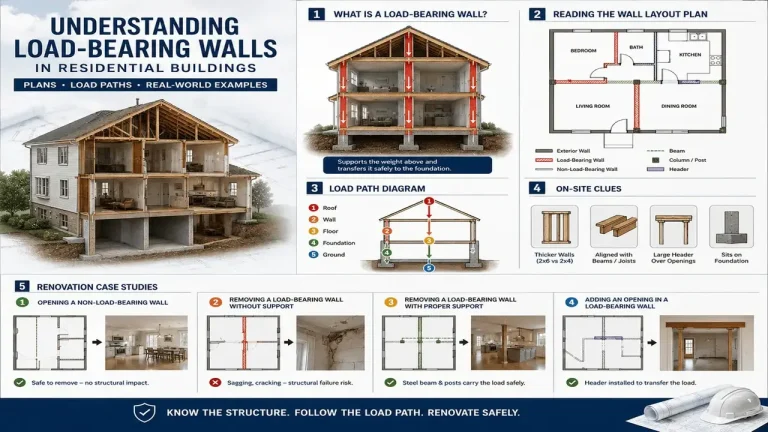
Check: Understanding Load-Bearing Walls in Residential Buildings
Check: Reinforced Concrete High-Rise Buildings: Key Construction Components Explained
Check: The Institution of Civil Engineers homepage | Institution of Civil Engineers (ICE)