Low-Carbon Concrete: Is It Worth It for Residential Buildings?
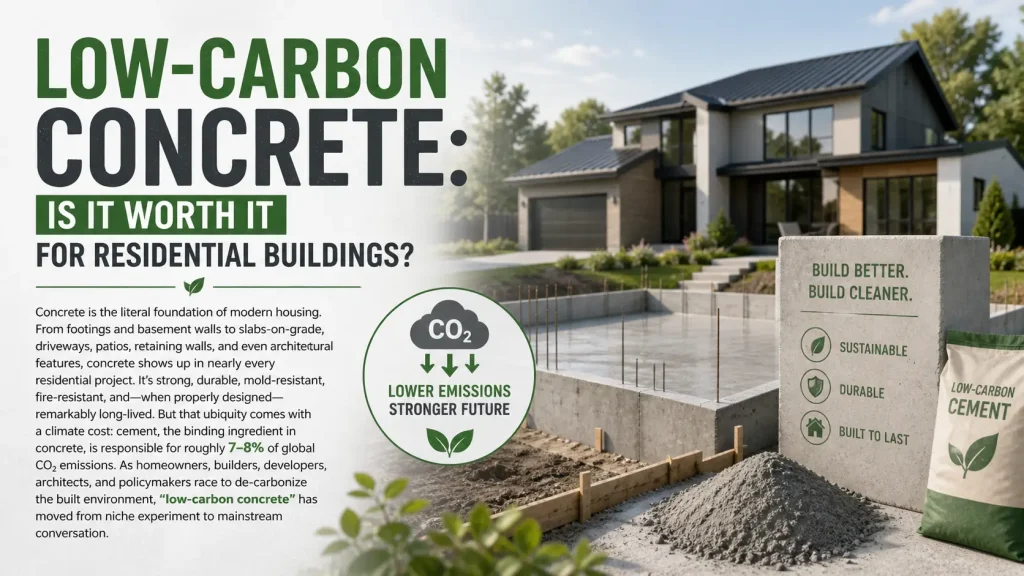
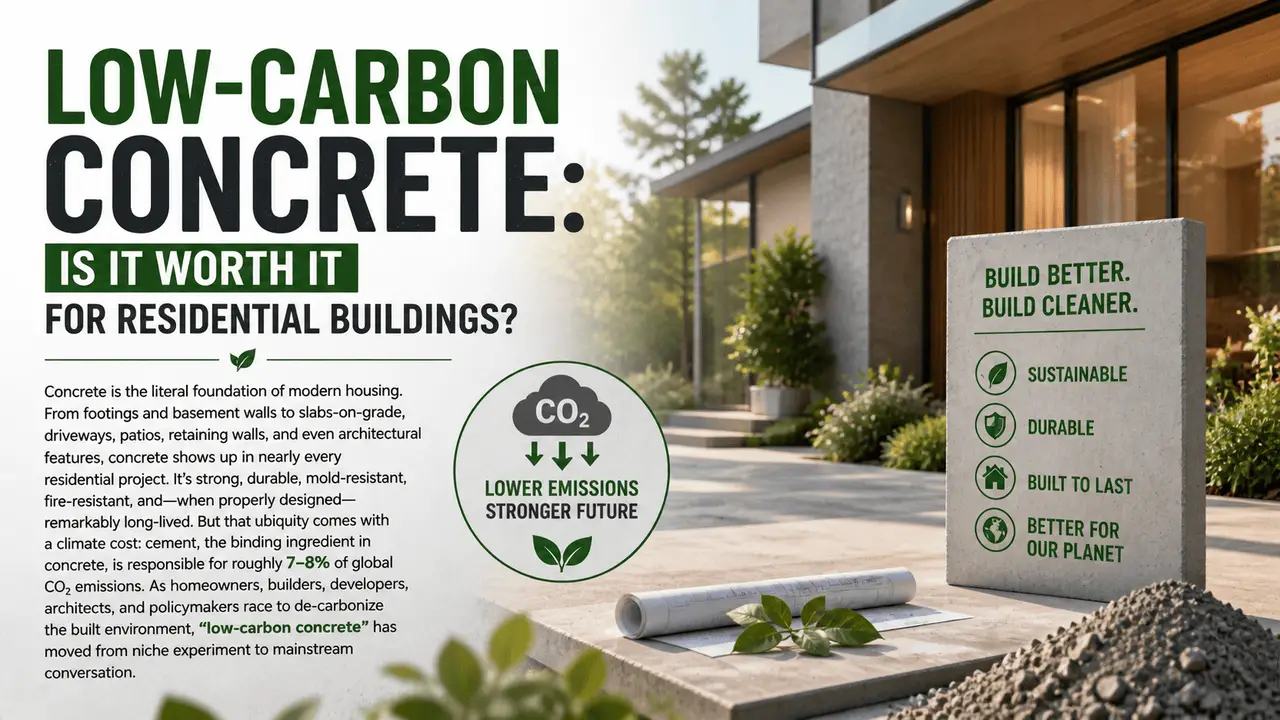
Concrete is the literal foundation of modern housing. From footings and basement walls to slabs-on-grade, driveways, patios, retaining walls, and even architectural features, concrete shows up in nearly every residential project. It’s strong, durable, mold-resistant, fire-resistant, and—when properly designed—remarkably long-lived. But that ubiquity comes with a climate cost: cement, the binding ingredient in concrete, is responsible for roughly 7–8% of global CO₂ emissions. As homeowners, builders, developers, architects, and policymakers race to decarbonize the built environment, “low-carbon concrete” has moved from niche experiment to mainstream conversation.
So the question is not whether concrete needs to decarbonize—it does. The real question for residential construction is: Low-carbon concrete: is it worth it for residential buildings? The answer, like most things in construction, is it depends—but in many real-world scenarios, the case is increasingly compelling. This article walks through what low-carbon concrete is, how it performs, what it costs, where the risks and trade-offs sit, how codes and supply chains affect feasibility, and what practical guidance homeowners and builders should follow to decide whether it’s worth specifying on their next residential project.
What exactly is “low-carbon concrete”?
“Low-carbon concrete” isn’t a single product with a single recipe. It’s an umbrella term for concrete mixtures and construction practices that reduce the embodied carbon footprint of concrete—typically measured in kilograms of CO₂-equivalent per cubic yard (kg CO₂e/yd³) or per cubic meter (kg CO₂e/m³)—while still meeting performance requirements (strength, durability, shrinkage, workability, curing behavior, etc.).
Key levers for reducing concrete’s carbon footprint include:
- Cement clinker reduction (supplementary cementitious materials, or SCMs). Ordinary portland cement (OPC) is made by heating limestone and other materials in a kiln, releasing CO₂ both from fuel combustion and from the chemical calcination of limestone. Replacing a portion of OPC with SCMs—such as ground granulated blast-furnace slag (GGBFS), coal fly ash, natural pozzolans, calcined clays, or silica fume—can substantially cut embodied carbon. Typical residential mixes might replace 20–50% of cement with SCMs; in some cases, higher replacement levels are feasible with careful mix design and curing.
- Portland-limestone cement (PLC) and other lower-clinker cements. PLC (often designated Type IL in the U.S.) intergrinds limestone with clinker, reducing clinker content (and therefore CO₂) by roughly 5–15% compared with traditional Type I/II cement—often with comparable performance for many residential applications.
- Optimized mix design and strength-to-performance matching. A common source of “carbon waste” in residential work is overdesign: specifying 4000 psi concrete everywhere “just in case,” when 3000 psi is structurally adequate for a slab-on-grade or footing in a given soil condition. Right-sizing strength, slump, air content, and durability requirements prevents unnecessary cement use.
- Admixtures and advanced water reducers. High-range water reducers (superplasticizers) allow lower water–cementitious ratios for a given slump, enabling strength with less cement. Set-control admixtures can also reduce rework and improve curing outcomes—indirectly lowering carbon by avoiding rejected loads or premature repairs.
- Carbon capture, utilization, and storage (CCUS) in cement/concrete; CO₂ mineralization; novel binders. Emerging technologies inject captured CO₂ into fresh concrete (where it mineralizes and improves strength in some systems) or produce alternative binders with lower process emissions. These solutions are promising but vary in availability, cost, and code acceptance by region.
- Low-carbon procurement and logistics. Sourcing locally, reducing waste (accurate quantity takeoffs, good placement practices), using recycled aggregates where appropriate, and minimizing truck idling can all contribute incremental—but meaningful—reductions.
Performance in residential applications: strength, durability, and constructability
For most residential uses—footings, stem walls, basement walls, slabs-on-grade, garage slabs, stoops, porches, driveways, and patios—the performance requirements are well within the capabilities of properly designed low-carbon mixes. That said, success depends on mix-specific behavior, not the label “low-carbon.”
- Strength gain and curing: High-SCM mixes (especially high slag or high fly ash) can gain strength more slowly in cool weather. This matters for residential schedules: you may need to protect concrete from cold, extend curing times, or adjust stripping/form removal expectations. Conversely, in hot, windy conditions, SCM mixes can help reduce thermal cracking risk by moderating heat of hydration.
- Workability and finishing: Some low-carbon mixes require tighter quality control on water addition at the jobsite (a notorious source of variability). Admixtures help, but the ready-mix supplier and contractor need to be aligned on slump targets, placement method (pump vs. direct chute), and finishing windows.
- Durability: Durability often improves with SCMs—fly ash and slag can reduce permeability, mitigating chloride ingress (helpful in coastal regions or where de-icing salts are used) and improving sulfate resistance when properly designed. Air entrainment remains critical in freeze–thaw climates; low-carbon concrete is not exempt from good durability practice.
- Cracking and shrinkage: Mix design, aggregate quality, joint layout, reinforcement, curing, and restraint conditions dominate cracking behavior. Low-carbon mixes can be tuned to perform equivalently to conventional mixes, but “drop-in” substitution without re-qualification is where problems occur.
- Color and aesthetics: For exposed architectural concrete (e.g., decorative patios, polished interior slabs, precast steps), SCMs can influence color and finishing characteristics. These effects are manageable—but they require coordination among the designer, supplier, finisher, and owner.
Bottom line: low-carbon concrete is not a gamble if it’s engineered, specified, tested, and placed correctly. It is a risk if treated as an off-the-shelf swap.
The carbon math: how big are the savings—and where do they come from?
The embodied carbon of a cubic yard of residential concrete can vary dramatically. A typical U.S. baseline (e.g., 4000 psi mix with 100% portland cement) might land around 400–500 kg CO₂e/yd³ (region- and plant-dependent). Practical low-carbon strategies commonly achieve:
- PLC substitution: ~5–15% reduction vs. Type I/II cement.
- Moderate SCM replacement (20–30% fly ash or slag): ~15–30% reduction.
- Higher SCM replacement (40–50%) with performance validation: ~25–40%+ reduction.
- Mix optimization (right-sized strength + admixtures): often an additional 5–15% reduction, sometimes with no cost premium.
- Emerging CCUS/mineralization technologies: early deployments report 5–10%+ reductions today, with potential for more as scale improves.
To put this in residential terms: a typical single-family home might use 30–80 yd³ of concrete (footings, walls, slab, flatwork, and miscellaneous). A 25% reduction across that volume translates to roughly 3–10 metric tons of CO₂e avoided per home—comparable to taking a gasoline car off the road for several months to a year, depending on assumptions. For production builders delivering hundreds of homes annually, the aggregate impact is substantial—and increasingly important for ESG goals, green building certifications, and local carbon regulations.
Cost: is low-carbon concrete worth it financially?
Cost is where many residential decisions live or die. The good news: low-carbon concrete is not automatically more expensive, and in many cases it’s cost-neutral or even cost-saving when implemented thoughtfully.
- Cost drivers that can increase price: specialized SCMs with limited regional availability; higher admixture dosages; additional testing (trial batches, maturity monitoring, strength verification); schedule impacts from slower strength gain in cold weather; contractor learning curve.
- Cost drivers that can decrease price: cement is typically the most expensive component in a mix; replacing cement with slag or fly ash (when locally available) can reduce material costs. Optimizing strength requirements avoids paying for cement you don’t structurally need.
- Market and regional variability: In regions with abundant slag (near steel-producing areas) or reliable fly ash supply, low-carbon mixes may be cheaper than conventional mixes. In regions where SCMs must be transported long distances—or where specifications are overly prescriptive—premiums of $3–$15/yd³ (or more) can appear, though this gap is narrowing as demand grows and suppliers adapt.
For a homeowner pouring a 40 yd³ foundation and flatwork package, a $5/yd³ premium is $200—often a rounding error in a project budget. For a production builder, even a $2/yd³ savings across thousands of yards is meaningful. And when lifecycle value is considered—reduced risk of permeability-related damage, better sulfate resistance in aggressive soils, and alignment with future code or incentive requirements—the financial case strengthens further.
Codes, standards, specifications, and risk management
One of the biggest practical barriers to low-carbon concrete in residential work isn’t technical performance—it’s specification language and approval pathways.
- Building codes: The International Residential Code (IRC) and local amendments typically reference ACI 318/332, ASTM C150/C595/C618/C989/C1240, and other standards. Low-carbon approaches—PLC, SCM-blended cements, performance-based mix designs—are generally compliant when properly tested and documented.
- Performance vs. prescriptive specs: Prescriptive specs (“4000 psi concrete with Type I/II cement only”) unintentionally block low-carbon options. Performance-based specs (“4000 psi at 28 days, max w/cm ratio 0.50, air content per exposure class, permeability target if applicable”) give ready-mix producers room to innovate while protecting the owner.
- Trial batches and submittals: For critical elements (basement walls, structural slabs, tall stem walls), require preconstruction trial batches, strength curves (7/14/28 days), air content, slump retention, and—where relevant—maturity calibration so field strength can be verified efficiently.
- Quality assurance/quality control (QA/QC): Low-carbon success correlates strongly with good QC: slump checks at delivery, proper curing (especially for SCM mixes), temperature monitoring in cold/hot weather, and cylinder breaks tracked against the mix’s expected gain curve.
- Insurance and warranties: Some builders worry that “non-standard” mixes invite pushback from insurers or warranty providers. In practice, documentation beats novelty: if the mix meets ASTM/ACI requirements and passes QA/QC, coverage concerns typically fade.
Practical residential use cases: where low-carbon concrete shines (and where to be careful)
High-value, low-risk wins (easy starting points):
- Slabs-on-grade and flatwork: Often overdesigned; excellent candidates for mix optimization and moderate SCM replacement.
- Footings and stem walls in moderate climates: With proper curing and strength verification, low-carbon mixes perform reliably.
- Driveways, patios, walkways: Big volume, visible sustainability benefit, and manageable structural demands—provided freeze–thaw durability (air entrainment) is handled correctly.
Cases requiring extra coordination:
- Cold-weather pours: High-slag or high-fly ash mixes may need heated enclosures, insulated blankets, maturity monitoring, or adjusted schedules.
- Fast-track construction: If you need early strength for form stripping or post-tensioning sequencing, work with the supplier to tune early-age performance (e.g., optimized admixtures, appropriate SCM levels, or a hybrid approach).
- Aggressive exposure conditions: Sulfate-rich soils, marine environments, heavy de-icing salt exposure, or industrial contaminants call for deliberate durability design (low permeability, correct cement type, proper curing), not casual substitution.
- Architectural finishes: Color consistency, bleed water behavior, and finishing timing can differ; mock-ups are essential.
Environmental impact beyond embodied carbon: the full lifecycle view
A rigorous answer to “is it worth it?” must look beyond cradle-to-gate embodied carbon. Key lifecycle considerations for residential concrete include:
- Durability and service life: A low-carbon mix that achieves equal or better durability can avoid future repairs, replacements, and the associated emissions—often dwarfing the initial savings. Conversely, poor curing that leads to cracking and spalling can erase the climate benefit via premature rehab.
- Thermal mass and operational energy: Concrete’s thermal mass can reduce heating and cooling loads in well-designed homes (especially when paired with insulation, passive solar orientation, and appropriate glazing). This doesn’t eliminate embodied carbon—but it improves whole-life performance.
- End-of-life: Concrete is highly recyclable as aggregate, though crushing and transport have impacts. Designing for disassembly is rare in homes, but reducing waste during placement (better formwork planning, accurate pours, avoiding over-ordering) is immediately actionable.
- Local ecosystem impacts: SCM sourcing matters—fly ash availability depends on coal plant operations (a transitioning grid complicates long-term supply), while slag is a byproduct of steelmaking. Responsible procurement includes verifying quality, consistency, and regional logistics.
How to specify and procure low-carbon concrete for a residential project (practical guidance)
If you’re a homeowner working with a contractor, or a builder standardizing across a development, these steps dramatically increase the odds that low-carbon concrete is worth it—technically, financially, and reputationally:
- Adopt performance-based specifications. Work from ACI 301/318/332 and ASTM standards, but emphasize performance targets (strength, w/cm ratio, air content by exposure class, shrinkage limits if relevant, permeability targets for aggressive soils). Allow PLC and SCMs explicitly.
- Engage the ready-mix supplier early. Bring them into preconstruction meetings. Ask for Environmental Product Declarations (EPDs) for the proposed mixes, regionally relevant benchmarks, and a clear carbon comparison vs. your current baseline.
- Run trial batches and mock-ups. For structural elements and any architectural finishes, verify strength gain curves, workability, setting time, finishing behavior, and color. Calibrate maturity sensors if you want rapid, non-destructive field strength verification.
- Plan for curing and weather. Specify curing methods (wet curing, curing compounds, blankets) appropriate to the mix and season. Put temperature and wind protocols in the pour plan.
- Optimize design to reduce volume. Rationalize slab thickness, footing sizes, and flatwork geometry. Coordinate with the structural engineer to avoid conservative overdesign. Less concrete = less carbon, full stop.
- Document and verify. Collect batch tickets, EPDs, QC logs, cylinder breaks, and photos. This supports green building certifications (LEED, Green Globes, Passive House, local stretch codes), ESG reporting, and homeowner confidence.
- Leverage incentives and requirements. Some jurisdictions, utilities, and green mortgage programs reward low-carbon materials. Conversely, emerging “buy clean” and embodied-carbon limits may make low-carbon concrete not just worth it—but required.
Case snapshots: what “worth it” looks like in the real world
- Custom single-family home (cold climate): A builder switched from a 100% Type I/II 4000 psi mix to a 30% slag-blended mix with PLC and performance-based curing requirements. Result: ~28% embodied carbon reduction, cost-neutral after accounting for a small increase in curing measures, and equal 28-day strength. Winter pours required insulated blankets and maturity monitoring—but the schedule impact was under two days across the whole project.
- Production subdivision (warm climate, high-volume flatwork): A developer standardized on 25% fly ash mixes for slabs, driveways, and sidewalks, paired with tighter QC on water addition at the site. Result: ~20% carbon reduction, $2.50/yd³ cost savings due to reduced cement content, and fewer callbacks related to surface dusting because permeability dropped.
- Coastal residence (chloride exposure): The engineer specified a low-permeability SCM mix (slag + optimized w/cm ratio) instead of a conventional mix with a corrosion-protection adder (extra cover, membranes). Result: higher upfront coordination, but lower lifetime maintenance risk and a stronger resilience story for insurance and resale.
The verdict: is low-carbon concrete worth it for residential buildings?
Yes—often, and increasingly so. But “worth it” depends on how you define value:
- Climate value: In nearly all cases, low-carbon concrete delivers meaningful, measurable embodied-carbon reductions with today’s commercially available technologies (PLC, SCMs, mix optimization, good curing). For climate-aligned builders and homeowners, that alone can justify adoption.
- Financial value: When SCMs are locally available and specifications allow performance-based innovation, low-carbon concrete can be cost-neutral or cheaper. Even when there’s a modest premium, it’s frequently small relative to total project cost—and can be offset by incentives, risk reduction, and marketing/ESG benefits.
- Performance and durability value: Properly designed low-carbon mixes can match or exceed conventional concrete in durability, especially for permeability-driven deterioration mechanisms. The key is QA/QC, curing, and weather planning—not the carbon label.
- Regulatory and market value: As codes tighten, disclosure requirements expand, and buyers become more carbon-literate, low-carbon concrete is shifting from a “nice-to-have” to a competitive necessity. Getting ahead of that curve reduces future rework and stranded-spec risk.
The caveats matter: low-carbon concrete is not a DIY sticker or an afterthought substitution. It rewards teams that collaborate early—owner, architect, structural engineer, contractor, and ready-mix supplier—around clear performance targets, trial batches, EPDs, and field QC. Treat it like any other engineered building system, and it will usually pay dividends.
If you’re planning a residential project and want to make low-carbon concrete work for you, start with three concrete actions this week: (1) request EPDs and low-carbon mix options from your local ready-mix plants, (2) update your concrete specs to be performance-based and explicitly allow PLC and SCMs, and (3) budget for trial batches and enhanced curing on your first few pours. Do those three things, and you’ll find that low-carbon concrete isn’t just worth it—it’s one of the highest-leverage, lowest-drama ways to cut a home’s embodied carbon without compromising safety, durability, or budget.
Check: Space Planning for a House: A Technical and Practical Approach