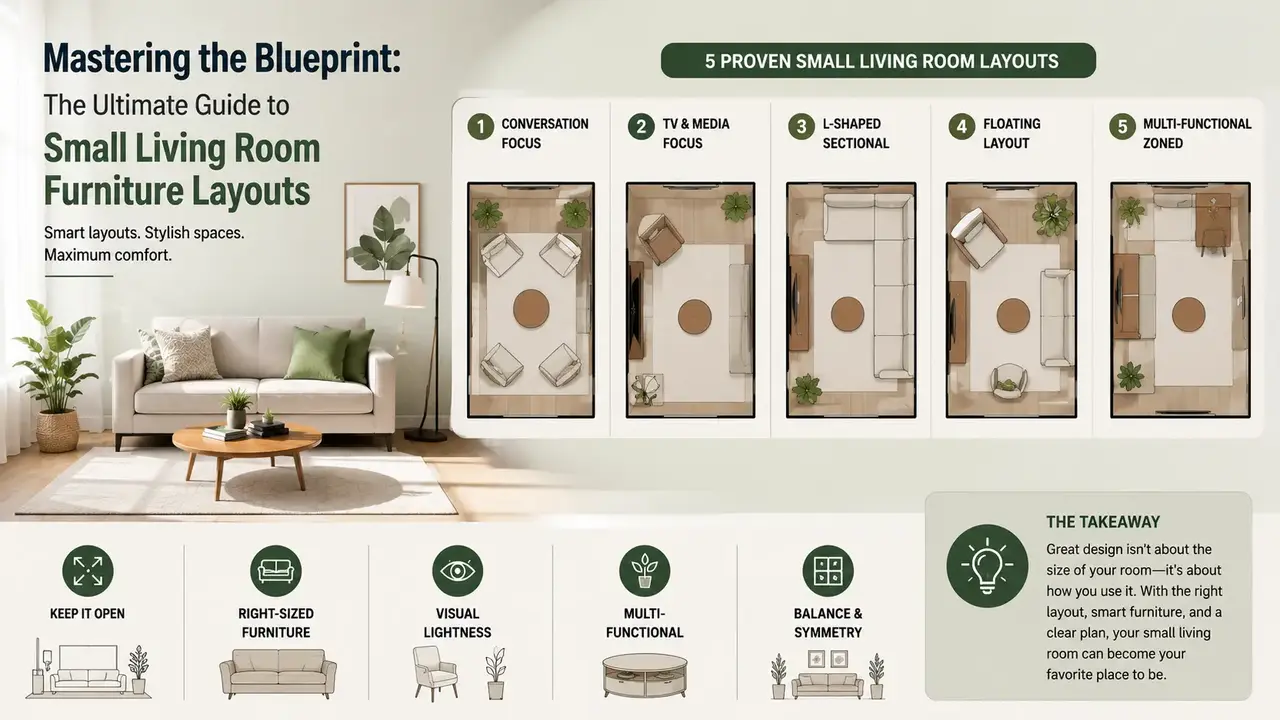
Mastering the Blueprint: The Ultimate Guide to Small Living Room Furniture Layouts
Living in a smaller footprint is an increasingly common reality of modern urban life. Whether you are occupying a cozy downtown studio, a historic brownstone with idiosyncratic dimensions, or a compact suburban townhouse, the living room remains the undisputed heart of the home. It is where we unwind after a demanding day, entertain guests, catch up on cinema, and occasionally log hours for remote work.
When square footage is premium, however, arranging furniture can easily feel like a stressful game of spatial Tetris. A single misplaced armchair or an oversized sofa can instantly choke traffic flow, make the room feel claustrophobic, and ruin the overall aesthetic.
The secret to conquering a small living room does not lie in sacrificing comfort or abandoning your personal style; it lies in strategic layout design and intelligent furniture selection. By understanding spatial geometry, human ergonomics, and visual weight, you can transform a cramped room into an airy, highly functional, and beautiful sanctuary.
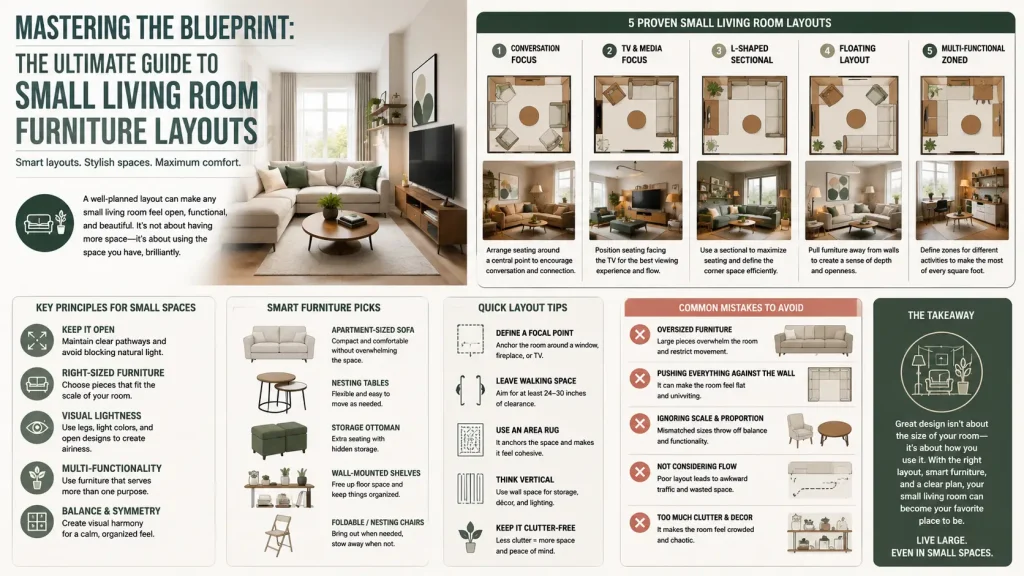
This comprehensive guide breaks down the fundamental rules of small-space design, details five proven layout archetypes with real-world examples, highlights essential furniture selections, and flags common mistakes to avoid.
Check: Low-Carbon Concrete: Is It Worth It for Residential Buildings?
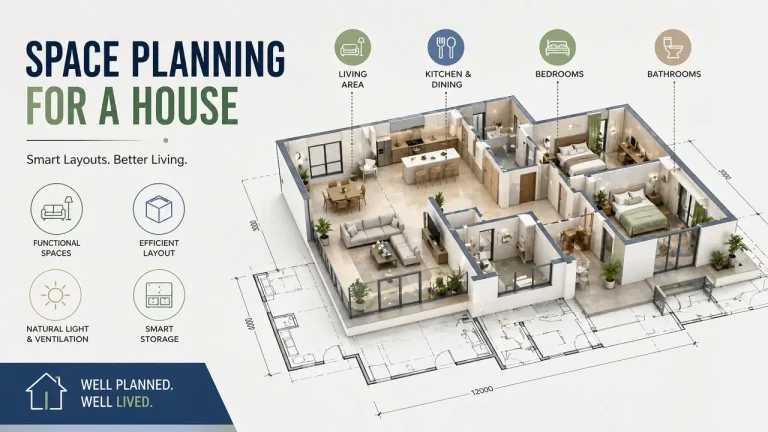
Check: Space Planning for a House: A Technical and Practical Approach
Part 1: The Golden Rules of Small-Space Spatial Design
Before moving a single piece of furniture or sliding your credit card at a design boutique, you must master the core principles of interior architecture tailored specifically for restricted spaces. These rules govern how the human brain perceives volume, comfort, and accessibility.
1. The Goldilocks Principle of Scale and Proportion
In a small living room, scale is everything. Large-scale furniture—such as a deep, rolled-arm Chesterfield sofa or a massive, rustic oak coffee table—will physically and visually overwhelm the room. Conversely, filling a small room with dozens of tiny, spindly pieces will make it look cluttered and fragmented.
You must strive for the “Goldilocks” zone: furniture with clean profiles, compact footprints, yet deep enough seating to remain genuinely comfortable. Pay close attention to the heights of your furniture as well; keeping profiles low to the ground allows the eye to travel across the room unobstructed, creating the illusion of a higher ceiling.
2. Clearance Zones and Traffic Flows
A layout is only successful if you can move through it effortlessly. Interior designers rely on strict clearance measurements to ensure a room feels comfortable:
- Primary Walkways: You need between 30 to 36 inches of clear pathway for major walking routes through a room.
- Coffee Table Clearance: Leave 14 to 18 inches between the front edge of your sofa and the edge of your coffee table. This keeps drinks within arm’s reach while leaving enough legroom to sit and stand comfortably.
- Pass-Through Space: Allow at least 24 to 30 inches between accent chairs, side tables, and media consoles to prevent a tight, maze-like environment.
3. Managing Visual Weight
Visual weight refers to how heavy an object looks based on its color, material, and structure. Understanding this concept allows you to trick the eye into thinking a room has more open volume than it actually does.
- Heavy Visual Weight: Solid base pieces, dark velvet upholstery, chunky box silhouettes, and opaque black metals. These stop the eye and make boundaries feel closer.
- Light Visual Weight: Legged furniture (where you can see the floor underneath), acrylic or glass surfaces, light-toned linens, woven cane, and open-frame metalwork. These allow light and sightlines to pass through, instantly expanding the room’s perceived borders.
4. Harnessing the Vertical Axis
When horizontal floor space is limited, look up. The walls of your small living room represent prime, underutilized real estate. Floor-to-ceiling shelving, tall floor lamps, vertical artwork arrays, and window draperies hung flush with the ceiling all serve to draw the eye upward. This shift in focus emphasizes the room’s height rather than its narrow floor plate.
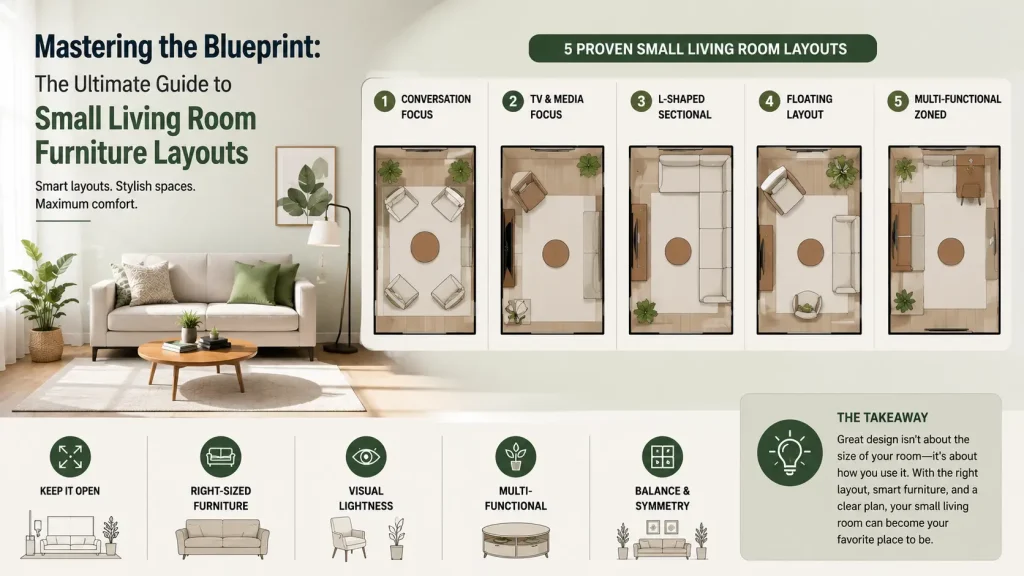
Part 2: 5 Primary Furniture Layout Archetypes (With Detailed Examples)
Every small living room possesses its own distinct geometry. Some are perfectly square but small; others are long, narrow tunnels; while many are open-concept zones that must share space with a kitchen or home office.
Below are five distinct layout archetypes engineered to solve specific spatial puzzles, illustrated with dimensional and contextual examples.
Layout 1: The Balanced Square (Best for 11’ x 11’ or 12’ x 12’ Rooms)
Square rooms can paradoxically be difficult to design because they risk looking boxy and static if all furniture is pushed against the perimeter walls. The goal here is to introduce softness, symmetry, and central grounding.
text+---------------------------------------------------+
|                     WINDOW                        |
|             +-----------------------+             |
|             |       8x10 RUG        |             |
|  +-------+  |   +---------------+   |  +-------+  |
|  |Slipper|  |   | Round Pedestal|   |  |Slipper|  |
|  | Chair |  |   | Coffee Table  |   |  | Chair |  |
|  +-------+  |   +---------------+   |  +-------+  |
|             |                       |             |
|             |   +---------------+   |             |
|             |   | Apartment-Size|   |             |
|             |   |     Sofa      |   |             |
|             +---+---------------+---+             |
|                    WALKWAY                        |
+---------------------------------------------------+
The Setup Strategy
Center your layout around a focal point, such as a window or a media wall. Instead of a massive sectional, opt for one sleek, apartment-size sofa (typically 70 to 75 inches wide) flanked by two low-profile, armless slipper chairs or Danish modern chairs. Ground the entire arrangement with an 8’ x 10’ area rug. Crucially, pull the sofa and chairs a few inches away from the walls—this “floating” technique instantly adds breathing room.
Real-World Example: “The Apartment Oasis”
- The Room: An 11-foot by 11-foot urban living room with a large window on the far wall and an entry door on the opposite wall.
- The Furniture:
- One 72-inch mid-century modern sofa upholstered in an oatmeal linen fabric with tapered wooden legs.
- Two open-frame walnut accent chairs placed opposite the sofa, angled slightly inward to encourage conversation.
- A 30-inch round glass-top pedestal coffee table in the center.
- A slim, wall-mounted floating media console directly underneath a wall-mounted television.
- Why It Works: The round coffee table breaks up the strict geometry of the square room and prevents bruised shins in tight clearances. Because the chairs and sofa are raised on legs, you can see the rug extending beneath them, making the entire floor plane feel continuous and expansive.
Layout 2: The Long & Narrow Galley (Best for 9’ x 15’ or 10’ x 18’ Rooms)
Long, rectangular living rooms often suffer from the “bowling alley” effect, where furniture is lined up down one side, leaving a cold, uninviting pathway down the other. The goal here is to create a functional conversational zone while maintaining a clear, straight walkway.
text+---------------------------------------------------+
|  +--------------------+      +-----------------+  |
|  |   Low-Profile      |      | C-Table         |  |
|  |   Streamlined Sofa |      |                 |  |
|  +--------+-----------+      +-----------------+  |
|           |   RUNNER RUG OR SLIM OVAL RUG          |
|           +-------------------+                    |
|           | Slim Oval Table   |                    |
|           +-------------------+                    |
|                                                   |
|  ===============================================  |
|  [CLEAR WALKWAY / TRAFFIC FLOW - 36" WIDTH]       |
|  ===============================================  |
|                                                   |
|  +-----------------------+                        |
|  | Wall-Mounted TV       |                        |
|  | & Shallow Console     |                        |
|  +-----------------------+                        |
+---------------------------------------------------+
The Setup Strategy
Place your sofa against one of the long walls, but choose a profile that is shallow (around 32 to 34 inches deep) rather than deep. On the opposite wall, mount the television directly to the drywall and place an ultra-shallow console underneath it (no more than 10 to 12 inches deep) to house media boxes. Use a long, slim oval coffee table or a pair of small nesting tables that can be tucked away when not in use.
Real-World Example: “The Brownstone Pass-Through”
- The Room: A 9.5-foot wide by 16-foot long narrow parlor room that functions as both a living space and a walkway to the kitchen.
- The Furniture:
- An 80-inch track-arm sofa in a light gray performance fabric positioned against the solid long wall.
- An oval wooden coffee table (42 inches long by 18 inches wide).
- One small accent stool or leather pouf tucked neatly next to the coffee table, providing extra seating without blocking sightlines.
- A wall-mounted TV opposite the sofa with a 10-inch deep floating shelf below it.
- Why It Works: By keeping all major furniture items pinned along one primary axis and utilizing an oval coffee table, a clear 36-inch walkway is preserved along the opposite side of the room. The floating shelf takes up zero footprint, keeping the floor entirely clear and making the room feel wider.
Layout 3: The L-Shaped Corner Anchor (Best for Open-Concept Layouts)
Many modern apartments lack a defined fourth wall, opening directly into the kitchen or dining area. In these scenarios, your layout must create its own boundaries and define the living room zone without relying on walls.
text+---------------------------------------------------+
|  [ KITCHEN / DINING ZONE ]                         |
|                                                   |
|        BACK OF CHAISE ACTS AS ROOM DIVIDER        |
|               |                                   |
|               v                                   |
|        +--------------+                           |
|        |   Chaise     |                           |
|        |   Lounge     |                           |
|  +-----+--------------+                           |
|  |                    |      +---------------+    |
|  |  Sofa Section      |      | Leather Pouf  |    |
|  |                    |      |               |    |
|  +--------------------+      +---------------+    |
|  |        8x10 ANCHOR RUG                    |    |
|  |             +-----------------------+     |    |
|  |             | Square Storage Ottoman|     |    |
|  |             +-----------------------+     |    |
|  +-------------------------------------------+    |
|                  WINDOW WALL                      |
+---------------------------------------------------+
The Setup Strategy
Counter-intuitively, a small sectional sofa can often work better than a traditional sofa-and-chair combo in an open-concept room. By placing an L-shaped sectional in the corner or floating it to face away from the kitchen, the back of the sofa acts as a physical room divider. This grounds the living area, creating an intimate, self-contained zone.
Real-World Example: “The Urban Studio Matrix”
- The Room: A 12-foot by 15-foot open-concept living area that flows directly off a single-wall kitchen.
- The Furniture:
- A compact, right-facing corner sectional (84 inches by 60 inches) positioned so the extended chaise portion projects into the room, delineating the edge of the living room boundary.
- A square upholstered storage ottoman that functions as a coffee table, footrest, and blanket storage all at once.
- A substantial 8’ x 10’ textured jute rug that physically anchors all components of the sectional.
- Why It Works: The sectional eliminates the need for multiple accent chairs, which would otherwise clutter the open floor plan. The chaise portion effortlessly creates a psychological separation between “the kitchen” and “the lounge” without blocking natural light or airflow.
Layout 4: The Minimalist Diagonal (Best for Awkward Angles and Ultra-Small Spaces)
When dealing with a space that is incredibly tiny (under 100 square feet) or plagued by multiple doorways, radiators, and awkward angled corners, traditional parallel placement falls apart. The solution is to think diagonally.
text+---------------------------------------------------+
|DIAGONAL CORNER                                    |
|  +-------------------------+                      |
|  |  Angled Media Cabinet   |                      |
|  +-------------------------+                      |
|                                                   |
|           +-------------------------+             |
|           |      Round Rug          |             |
|           |   +-----------------+   |             |
|           |   | Small Hexagon   |   |             |
|           |   | Side Table      |   |             |
|           |   +-----------------+   |             |
|           +-------------------------+             |
|                                                   |
|               +-----------------------+           |
|               | Small Loveseat /      |           |
|               | Settee Angled Parallel|           |
|               +-----------------------+           |
+---------------------------------------------------+
The Setup Strategy
Angling your primary seating arrangement at a 45-degree angle relative to the room’s corners can disrupt a tight layout in a surprising way. It draws attention to the furthest corners of the room (the longest sightlines in any rectangular box) and creates unique, triangular negative spaces behind furniture that can house statement floor lamps or tall potted plants.
Real-World Example: “The Historic Micro-Condo”
- The Room: An old building layout measuring 8.5 feet by 10 feet, featuring a corner radiator and an off-center window.
- The Furniture:
- A refined, 60-inch upholstered loveseat settee angled diagonally across from the corner radiator.
- A 6-foot round woven cotton rug placed beneath the loveseat to soften the diagonal orientation.
- A small hexagonal ceramic side table serving as a flexible coffee table alternative.
- A corner media unit directly across from the angled loveseat.
- Why It Works: By shifting the orientation away from the walls, the furniture avoids hugging tight walls or blocking the radiator. The triangular spaces left behind the angled sofa provide a neat place to put a tall brass floor lamp, adding layered warmth without eating up central floor space.
Layout 5: The Multifunctional Zone Matrix (Best for Living-Dining-WFH Combos)
For many professionals and urban dwellers, the living room must also do double-duty as a dining room and a functional home office. This layout focuses on maximizing utility without looking like a chaotic corporate cubicle.
text+---------------------------------------------------+
|  +-------------------+     +-------------------+  |
|  | Floating Desk     |     | Accent Armchair   |  |
|  | (Under-Window WFH) |     | (Dual-Purpose)    |  |
|  +-------------------+     +-------------------+  |
|                                                   |
|        +---------------------------------+        |
|        |          AREA RUG               |        |
|        |   +-------------------------+   |        |
|        |   | Streamlined Tailored    |   |        |
|        |   | Sofa                    |   |        |
|        |   +-------------------------+   |        |
|        |   +-------------------------+   |        |
|        |   | Nesting Tables          |   |        |
|        |   +-------------------------+   |        |
|        +---------------------------------+        |
|                                                   |
|  +-------------------+                            |
|  | Drop-Leaf Dining  |                            |
|  | Table (Wall-Flush)|                            |
|  +-------------------+                            |
+---------------------------------------------------+
The Setup Strategy
Divide the room using high-contrast zoning. Keep the center focused entirely on comfort and relaxation using a tailored sofa and nesting tables. Reserve the peripheral corners or alcoves for vertical, wall-mounted workstations or drop-leaf dining tables that fold completely flat when not in use.
Real-World Example: “The Multi-Hyphenate Hub”
- The Room: A 12-foot by 14-foot rectangular room that must support a remote marketing manager’s work hours, dining needs, and evening relaxation.
- The Furniture:
- A tight-back tailored sofa centered on a neutral wool rug.
- A slim, wall-mounted ladder desk tucked into the corner alcove, featuring overhead storage shelves to minimize desk surface clutter.
- An elegant, upholstered accent armchair that sits elegantly in the living room lounge during the evening, but easily rolls over to the desk to serve as an ergonomic office chair during the workday.
- A drop-leaf wooden table flush against the back wall, functioning as a console display until raised for dinner guests.
- Why It Works: The room avoids feeling cluttered because the heavy work equipment (desk and shelving) is vertical and mounted to the wall. Using a dual-purpose accent chair eliminates the need for an unsightly office task chair, preserving the cozy aesthetic of the living space.
Part 3: Strategic Furniture Selection for Small Spaces
Having the right layout plan is only half the battle; you must also select the correct furniture pieces to populate your floor plan. When shopping for a small living room, every piece of furniture must prove its worth by delivering high utility, smart storage, or low visual weight.
1. The Power of Multifunctional and Hybrid Pieces
In a small space, a piece of furniture that only performs one function is a luxury you cannot afford. Seek out clever multi-use furniture:
| Furniture Piece | Primary Function | Secondary/Hidden Function | Space-Saving Benefit |
|---|---|---|---|
| Storage Ottoman | Footrest / Coffee Table | Blanket & Board Game Storage | Eliminates need for extra storage chests. |
| Nesting Tables | Side Table Profile | Expands into Multiple Drink Surfaces | Tucks away neatly, opening up center floor space. |
| Sleeper Sofa/Daybed | Daily Seating | Guest Accommodation | Negates the need for a dedicated guest bedroom. |
| Drop-Leaf Console | Wall Accenting | Expands into a 4-Person Dining Table | Preserves open pathways during daily routines. |
2. Sofa Strategies: To Sectional or Not to Sectional?
The most common mistake in small-space design is assuming you can only buy a tiny, uncomfortable loveseat. Loveseats are often problematic because they can only fit two adults snugly, forcing you to buy additional armchairs that clutter the floor plan.
- When to buy a Sofa + Chair: Choose this setup if your room has multiple architectural interruptions, such as doorways, low windowsills, or fireplaces. It offers the highest layout flexibility.
- When to buy a Compact Sectional: Choose this if you have a solid, clear corner or an open-plan room. A sectional maximizes seating capacity per square foot, allowing you to lounge comfortably without needing extra chairs. Look for sectionals with a reversible chaise option, allowing you to switch the orientation from left to right if you relocate.
3. Opt for Elevated, Legged Silhouettes
As established in the visual weight section, look for furniture that stands proud on legs. Mid-century modern, Scandinavian, and contemporary styles excel at this design trick. By raising a sofa, credenza, or armchair 6 to 8 inches off the ground, light bounces underneath the frame, expanding your perception of room depth.
4. Transparent and Open-Frame Profiles
In corporate boardrooms and dense apartments alike, materials like clear acrylic (Lucite) and glass are a designer’s best secret weapon. A coffee table made from clear acrylic provides the exact same functional surface area as a solid wooden block, yet visually it occupies zero space. If glass isn’t your style, look for open-frame metal coffee tables or woven rattan stools that preserve clear sightlines.
Part 4: Common Layout Mistakes to Avoid
Sometimes, fixing a small living room layout is not about adding anything new, but rather eliminating design mistakes. Make sure your layout isn’t suffering from these common design errors:
1. The “Waiting Room” Phenomenon
This occurs when an inhabitant pushes every single piece of furniture flush against the perimeter walls in an attempt to open up a central space. The result is a cold, hollow layout where guests sit far apart, facing a barren expanse of rug.
The Fix: Pull your seating arrangements inward by even just 3 to 5 inches. This simple adjustment creates immediate intimacy, softens the geometry of the walls, and makes the room look intentionally styled rather than thrown together.
2. The Micro-Rug Trap
Many small-space dwellers buy a small rug (such as a 4’ x 6’ or 5’ x 7’ accent mat) assuming it will match their small room. However, a tiny rug sitting under a coffee table like a small postage stamp visually shrinks the room, segmenting the floor plane and making it look boxy.
The Fix: Buy a larger rug—ideally an 8’ x 10’ or at least a 6’ x 9’. The rule of thumb is that at least the front feet of all major seating pieces should rest firmly on the rug. A large rug unifies the space, anchoring your furniture and making the seating area look expansive and continuous.
text       INCORRECT (The "Postage Stamp" Rug)
       +-----------------------------------+
       |  [ SOFA ]                         |
       |         +---------------+         |
       |         |   TINY RUG    |         |
       |         | [Coffee Table]|         |
       |         +---------------+         |
       |                         [CHAIR]   |
       +-----------------------------------+
       *Visual Result: Disjointed, feels smaller.*

       CORRECT (The Unified Anchor Rug)
       +-----------------------------------+
       |  +------------------------+       |
       |  | [ SOFA (Front Legs) ]  |       |
       |  |                        |       |
       |  |      [Coffee Table]    |       |
       |  |                        |       |
       |  | [CHAIR (Front Legs)]   |       |
       |  +------ LARGE RUG -------+       |
       +-----------------------------------+
       *Visual Result: Cohesive, expansive zone.*
3. Blocking Natural Source Paths
Never allow your furniture arrangement to physically cross the threshold of a window frame or a doorway walkway. Blocking natural light casts heavy shadows across a small room, reducing perceived airiness.
The Fix: If you must position a sofa near a window wall, choose a low-slung, low-back modern sofa that sits below the windowsill line, allowing daylight to flood into the space unimpeded.
4. Over-Accessorizing and Visual Noise
A small living room layout will quickly look chaotic if every available surface is stacked with books, art pieces, throw pillows, and decorative items.
The Fix: Adopt a philosophy of editing. Instead of six small decorative objects on a side table, choose one single, impactful sculptural vase. When it comes to art, opt for one large, frame-focused canvas rather than a cluttered gallery wall of fifteen miniature frames. Clean surfaces create psychological breathing room.
Part 5: Step-by-Step Blueprint to Execution
Now that you are armed with the layout archetypes and furniture buying principles, follow this systematic workflow to execute your new small living room plan without any logistical missteps:
- Measure Twice, Buy Once: Draw a simple map of your room on grid paper or use a free digital floor-plan app. Note the exact locations of wall outlets, heating vents, window depths, and door swings.
- Define Your Essential Priority: Decide how the room will actually be used 80% of the time. Is it for solo TV watching, remote working, or hosting friends for drinks? Let that primary function dictate which furniture piece gets the absolute best real estate in your layout.
- Map It Out with Painter’s Tape: Before buying new furniture or moving heavy items, outline the exact dimensions of prospective pieces on your bare floor using blue painter’s tape. Walk through the taped outline for a few days to ensure you can move comfortably through the clearance zones.
- Invest in Strategic Lighting: Layer your lighting to maximize your layout. Do not rely on a single harsh overhead dome light, which can cast flat shadows that shrink a room. Instead, place a tall floor lamp in a far corner, a small table lamp on a side shelf, and a pair of wall sconces. Layered illumination softens wall boundaries and adds visual warmth.
Conclusion: Embellishing the Compact Footprint
Designing a small living room is an empowering creative exercise in editing and optimization. True luxury does not require thousands of cavernous square feet; it lives in thoughtful execution, intentional design, and functional harmony.
By selecting furniture with light visual weight, maximizing vertical real estate, preserving clear 30-inch traffic paths, and anchoring your space with a generous area rug, you can craft a living room that feels open and effortlessly inviting.
Identify your room’s unique geometry, select the layout archetype that matches your lifestyle, edit out the clutter, and enjoy a beautifully designed small living space that punches far above its weight class.
Check: The Institution of Civil Engineers homepage | Institution of Civil Engineers (ICE)