Designing with Cold in Mind -Sustainable Architecture · Sweden Guide
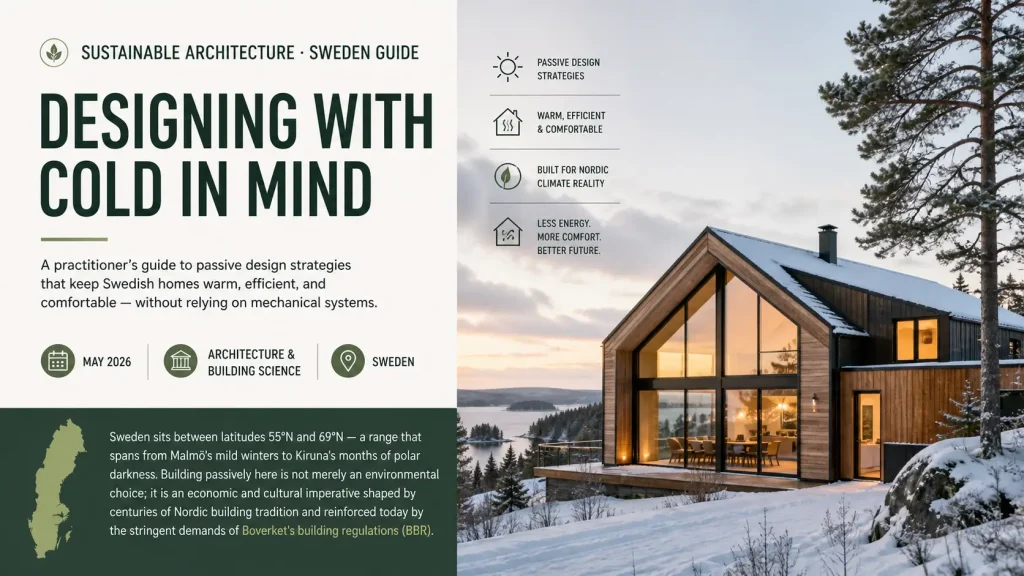
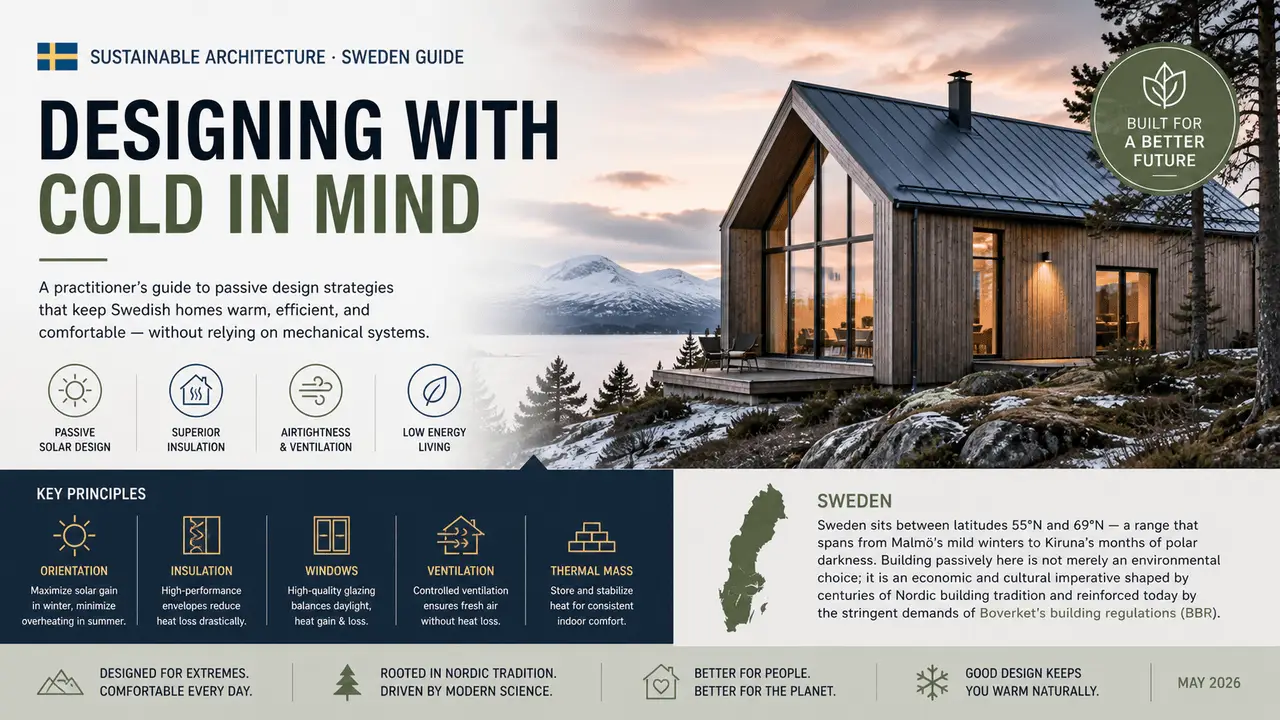
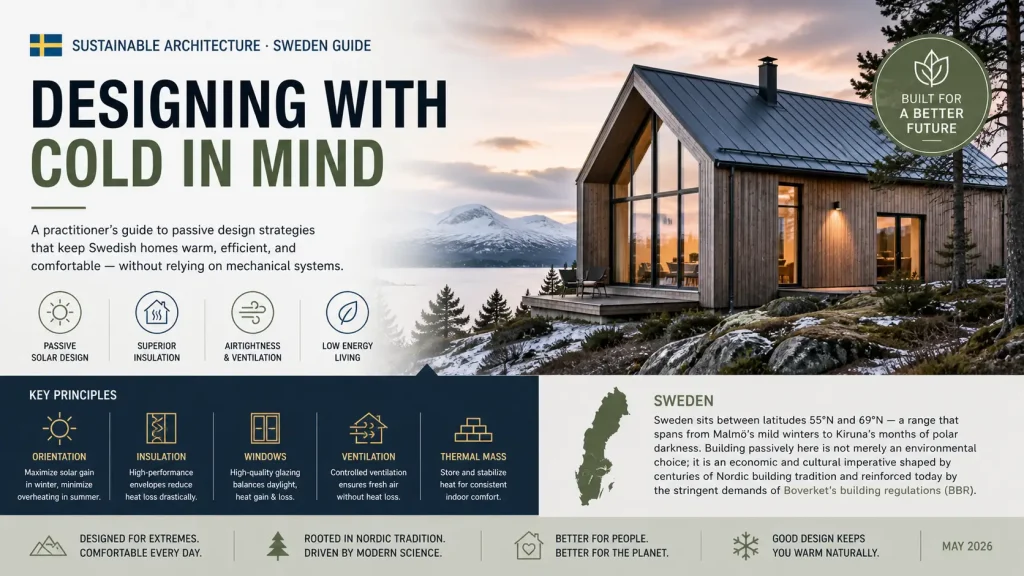
A practitioner’s guide to passive design strategies that keep Swedish homes warm, efficient, and comfortable — without relying on mechanical systems.
Sweden sits between latitudes 55°N and 69°N — a range that spans from Malmö’s mild winters to Kiruna’s months of polar darkness. Building passively here is not merely an environmental choice; it is an economic and cultural imperative shaped by centuries of Nordic building tradition and reinforced today by the stringent demands of Boverket’s building regulations (BBR).
Passive design means shaping a building so that the physics of heat, light, wind, and moisture do the work of comfort. The goal is to minimise energy demand before any mechanical system is introduced. In Sweden’s climate — defined by cold, long winters; short but intense summers; and significant variation between north and south — this demands a specific, layered toolkit.
−40°C Record winter low in northern Sweden (Norrland)
1,700+ Heating degree days per year in Stockholm
50 kWh Max primary energy use per m² in BBR 2024
≥0.8 South-facing window-to-floor ratio target for passive solar
Understanding the Swedish Climate
Before applying any strategy, a designer must be fluent in what the climate actually demands. Sweden’s climate is broadly continental-maritime with strong subarctic influence in the north. The critical design drivers are:

Swedish heating season spans roughly six months in the south and up to eight in the north. Design decisions must serve both extremes.
The heating season dominates. Overheating is a secondary concern but increasingly relevant as summers intensify. Daylight hours drop to as few as four per day in December in northern regions, making solar gain both precious and spatially directional. Ground frost depth can reach 150–250 cm in Norrland, with direct implications for foundation insulation.
“The building envelope is the most important mechanical system in a cold climate. Every centimetre of insulation is an investment that pays dividends for the entire life of the building.”
1. Building Form and Compactness
The single most powerful passive strategy in a cold climate is compactness. Heat loss is proportional to surface area; reducing the surface-to-volume ratio (A/V) directly reduces the rate at which a building loses warmth to the outside.
◈Surface-to-Volume Ratio
A cube is the theoretically optimal form. In practice, aim for A/V ratios below 0.8 m⁻¹ for low-energy buildings. Each projecting wing, dormer, or bay window increases the ratio. Cluster programme into compact, interlocking volumes and minimise exposed corners.
◉Attached and Semi-Detached Forms
Row houses and terraces share party walls, dramatically cutting exposed envelope area per dwelling. This is why Swedish urban vernacular has long favoured continuous street frontages — it is passive design encoded in city form.
◐Buried and Bermed Volumes
Ground temperature below frost depth stabilises at around +5–8°C throughout the year, far warmer than winter air. Berming earth against north walls or placing storage, parking, and utility rooms below grade reduces exposed cold-side envelope considerably.
2. Orientation and Solar Access
Sweden’s solar geometry is characterised by low solar angles — approximately 7° at winter solstice in Stockholm, rising to 55° in summer. This low winter sun can be captured effectively through south-facing glazing but is easily blocked by obstructions; careful site analysis is essential.
The optimal building orientation places the primary living spaces and largest glazed surfaces on the south to south-southeast façade (between 150° and 210° from north). Service spaces — stairwells, bathrooms, stores, and utility rooms — buffer the cold north side. This single decision can reduce heating demand by 10–20% compared to an arbitrarily oriented building with the same envelope performance.
South facade
Maximum glazing for solar gain. Deep overhangs or loggias prevent summer overheating while admitting low winter sun.
North facade
Minimum openings. Triple-glazed with small panes. Buffer with service rooms and circulation where possible.
East facade
Moderate glazing for morning light. Valuable in bedrooms and kitchens. Modest solar gain.
West facade
Use with caution — afternoon summer sun can cause overheating. Deciduous planting provides seasonal shading.
3. Super-Insulation and the Thermal Envelope
Swedish building practice has pioneered dense, continuous insulation. The Passivhus standard (Sweden’s version of Passive House) specifies envelope U-values well below the already stringent BBR requirements. In practice, high-performance new construction achieves the following targets:
▣Roof and Ceiling
400–500 mm of blown cellulose or mineral wool is standard for passive buildings. The roof is the primary heat-loss surface in single-storey structures. U-value targets: 0.07–0.10 W/m²K.
▣Walls
Prefabricated timber frame construction dominates in Sweden. Load-bearing I-stud or Larsen truss frames with 200–350 mm mineral wool or wood fibre, plus a service cavity to keep penetrations outside the primary insulation layer. U-value targets: 0.08–0.12 W/m²K.
▣Floor Slab
150–250 mm of EPS beneath the slab. Critical that insulation extends beyond the slab edge to prevent thermal bridging at the ground-floor perimeter — a common failure point causing cold floors and condensation risk.
Thermal bridges: the hidden enemyEven a highly insulated wall with a single steel tie, balcony connection, or window reveal that bypasses insulation can account for 15–30% of total envelope heat loss. Swedish regulations now require thermal bridge analysis per EN ISO 14683. Detail every junction before construction begins.
4. Airtightness and Controlled Ventilation
A leaky building cannot be a passive building. Uncontrolled air infiltration bypasses insulation and drives condensation into the structure. Swedish standards require airtightness testing (blower door) at completion; Passivhus requires ≤0.3 air changes per hour at 50 Pa pressure difference (n₅₀).
The airtight layer — typically a polyethylene membrane or airtight OSB board on the warm side of the insulation — must be continuous and must be designed into the construction sequence, not added as an afterthought. Every penetration (electrical conduit, pipe, ventilation duct) is a potential leak point and must be sealed with pre-formed grommets or elastic sealant.
A perfectly airtight building requires mechanical ventilation. The Swedish standard is a heat recovery ventilation (HRV) unit — Från-till-luft — with a heat exchange efficiency of 80–90%. Fresh filtered air is supplied to living areas; exhaust is drawn from kitchens and bathrooms. The recovered warmth from outgoing stale air preheats incoming fresh air, reducing ventilation heat loss by up to 85%.
5. Windows and Glazing Strategy
Windows are thermally the weakest element of any cold-climate envelope. Triple glazing with low-e coatings and argon or krypton fill is the baseline for serious passive design in Sweden. Well-specified triple-glazed units achieve centre-pane U-values of 0.5–0.6 W/m²K and overall frame U-values of 0.8–1.0 W/m²K.
Beyond U-value, two properties matter greatly: the solar heat gain coefficient (SHGC or g-value) and the visible light transmittance. South-facing windows in cold climates benefit from a higher g-value (0.50–0.62) to maximise winter passive solar gain. North-facing windows can use a lower g-value to reduce thermal loss while maintaining daylight.
“In Sweden’s cold climate, a well-placed south window is a heating appliance. The question is whether you size and specify it correctly.”
Thermal comfort near glazing is as important as U-value. A triple-glazed unit with a warm-edge spacer bar and proper installation brings the inner glass surface temperature close to room temperature, eliminating the cold-radiation effect that drives occupants away from windows — and drives up thermostat settings.
6. Passive Solar Heating
In a well-insulated building, internal gains from occupants, appliances, and lighting already contribute significantly to heating. Passive solar adds a direct collection layer. The principle is simple: south-facing glass admits shortwave solar radiation, which is absorbed by thermal mass (concrete floors, masonry, water) and re-emitted as longwave radiation — trapped inside by the glass.
For passive solar to be effective in Sweden, three elements must work together: south-facing glazing area of at least 8–12% of floor area; adequate thermal mass within the direct gain zone (at least 8 cm of concrete or masonry per m² of south glazing); and external shading that blocks the high summer sun but admits the low winter sun. A fixed overhang can be calculated using the local solar angle to achieve this balance precisely.
7. Thermal Mass and Phase Change
Timber-framed Swedish houses traditionally have low thermal mass. Adding it strategically — a poured concrete slab on grade, a mass masonry feature wall, or tile over a concrete substrate — provides the flywheel effect that smooths temperature swings from solar gain, occupant loads, and intermittent heating.
In a Passivhus, because the heating load is so small, thermal mass primarily serves comfort rather than energy storage: it prevents overheating on sunny winter days and delays the peak temperature on summer afternoons. Phase change materials (PCMs) embedded in wallboards offer a lightweight alternative for timber construction, storing 5–14 times more energy per unit mass than concrete at the phase transition temperature.
8. Wind Protection and Site Planning
Wind-driven infiltration and convective heat loss from the building surface can add significantly to the calculated fabric heat loss in exposed Swedish sites. Site planning choices that reduce wind exposure are free energy savings.
◎Windbreaks and Shelterbelts
Coniferous planting on the north and northwest sides reduces wind speed at the building surface. A shelterbelt at 2–3× tree height distance from the building provides the optimal wind shadow. Norwegian spruce and Scots pine are appropriate native species in Swedish conditions.
◎Entry Vestibules and Buffer Zones
A double-door airlock at primary entrances prevents cold air from spilling directly into heated space when doors open. Unheated enclosed porches (svalgang) serve the same function and are a well-established feature of Swedish vernacular architecture.
9. Moisture Management and Vapour Control
Cold climates create steep vapour pressure gradients across the building envelope — interior humidity drives moisture toward the cold exterior through diffusion and air leakage. Moisture accumulation within the structure leads to mould, rot, and structural degradation.
The vapour control layer (VCL) — typically the same membrane as the airtight layer — must be placed on the warm side of the insulation. In Sweden’s climate, variable-permeance membranes (smart vapour barriers) are increasingly used: they are vapour-tight in winter when driving pressures are high, and open in summer to allow any accumulated moisture to dry inward. Exterior cladding must always include a well-ventilated air gap to allow outward drying.
Designing by Climate Zone
BBR divides Sweden into three climate zones with progressively stricter energy requirements. Passive strategies should be scaled accordingly.
Zone I — Norrland
Extreme cold. Prioritise compactness, super-insulation (U-wall ≤ 0.09), and limit north glazing to the minimum required for daylight and egress. HRV essential.
Zone II — Central Sweden
Moderate to cold winters. All strategies apply. Balance passive solar gain against summer overheating risk, particularly in well-insulated buildings.
Zone III — Southern Sweden / Skåne
Mild maritime winters. Passive solar more effective; solar shading more critical. Airtightness and HRV remain important but heating loads are lower.
Passivhus Standard
≤15 kWh/m²/yr heating demand (Zone I) to ≤10 kWh/m²/yr (Zone III). Achievable by combining all strategies above with exceptional attention to detail.
A Practical Design Checklist
- Orient primary living spaces and maximum glazing to the south
- Minimise surface-to-volume ratio — favour compact rectangular forms
- Specify triple glazing with warm-edge spacers on all elevations
- Design continuous airtight layer before structural drawings are finalised
- Eliminate thermal bridges at slab edges, balcony connections, and window reveals
- Insulate foundation perimeter to full frost depth
- Specify HRV unit with ≥80% heat recovery efficiency
- Size south overhangs to block summer sun, admit winter sun
- Include thermal mass in the direct solar gain zone
- Plan windbreak planting or buffer zones on exposed northwest exposures
- Specify variable-permeance vapour control layer with ventilated cladding gap
- Conduct blower door test at practical completion — target n₅₀ ≤ 0.5 for standard low-energy, ≤ 0.3 for Passivhus
Beyond the building: district and landscape scaleIndividual passive buildings perform best when embedded in thoughtful site planning. Dense urban grain reduces wind exposure. District heating networks (fjärrvärme) — dominant in Swedish cities — pair well with low-energy buildings that have flat, predictable loads. Plan buildings, streets, and landscaping together rather than optimising each in isolation.
Conclusion
Passive design in Sweden is not a single strategy but an integrated system — form, orientation, insulation, airtightness, glazing, mass, moisture, and site working together. The good news is that each element reinforces the others: a more compact form needs less insulation to achieve the same performance; a better-insulated and more airtight building makes solar gain more effective because heat isn’t bleeding away the moment it enters.
The Swedish building tradition has always understood this at an intuitive level. The compact farmhouse facing south, the enclosed vestibule, the heavy roof — these are passive strategies encoded over generations. Contemporary practice adds precision: simulation tools, certified standards, measured performance. Together, they make it possible to build comfortably in one of Europe’s most demanding climates using remarkably little energy — and no active heating system at all for buildings that meet the Passivhus criterion.
The coldest months are not an obstacle. They are the design brief.
Referenced standards: Boverkets byggregler (BBR 2024) · SVEBY (Standardize energy use in buildings) · Sverige Passivhus & Minenergi (FEBY 2021) · EN ISO 52000 series · Energimyndigheten climate zone map. All U-value targets are indicative and should be verified against current regulation for the specific project type and climate zone.
Check: Space Planning for a House: A Technical and Practical Approach
Check: Top 10 Materials for Interior Finishes: The Ultimate Guide to Creating Beautiful Spaces
Check: Swedish Institute for Standards, SIS – Swedish Institute for Standards, SIS